If you’ve ever used night vision goggles (NVGs) during a low-light or nighttime activity, you might’ve noticed a small, easy-to-overlook dial on the side or front of the device that doesn’t look like much at first glance. That dial is gain control, and it’s one of the most critical, yet most misunderstood, features of any NVG. As a supplier of night vision goggles for over a decade, I’ve seen firsthand how misadjusting gain control can turn a crisp, clear image into a blurry, overexposed mess—or leave you squinting at a pitch-black screen when you need visibility most. Today, I’m breaking down exactly what gain control is, how it works, why it matters, and how to use it effectively, with real-world examples from the NVGs we design and sell for hunting, outdoor adventures, and tactical use.


Let’s start with the basics: how night vision works in simple terms. Most modern NVGs (second, third, and fourth generation) use image intensifier tubes to amplify tiny amounts of existing light—starlight, moonlight, even faint ambient glow from distant streetlights—into a bright, visible image. Without this amplification, that faint light would be too dim for the human eye to pick up, especially in remote areas with no artificial illumination. But here’s the catch: image intensifiers can only handle so much light before they’re overwhelmed. If too much light hits the tube at once, it saturates, turning the entire image blinding white, washing out any details, and even risking long-term damage to the intensifier itself. That’s where gain control comes in.
Put plainly, gain control is a manual or automatic adjustment that regulates how much the image intensifier tube amplifies incoming light. Think of it like the volume knob on a stereo: turn it up, and you make quiet sounds louder; turn it down, and you lower the volume to avoid distortion. For NVGs, gain control does the exact same thing with light: crank it up in near-total darkness (when there’s almost no ambient light to begin with) to make the faint glow from a single star or the moon visible, and turn it down when you encounter unexpected bursts of light—like a flashlight, a distant campfire, or even the bright headlights of a parked vehicle—to prevent overexposure and keep your image intact.
Now, you might be wondering: why not just make NVGs with automatic gain control (AGC) that does this all for you? AGC is common in some entry-level NVGs, but it has significant limitations, especially for professional or serious recreational use. Let’s take an example from the Flip Side Up Design Night Vision Goggles, one of our most popular mid-tier models. The Flip Side Up design is favored by hunters and outdoor enthusiasts because it lets you flip the entire unit up and out of the way when you don’t need it, which is perfect for walking back to a trailhead or stopping at a campfire to warm up. But when you’re mid-hunt, waiting for hours in a tree stand with no light, automatic gain control might not be fast enough to adjust when you shift your gaze from a dark forest to a faint patch of moonlight on a treetop. It could overamplify the moonlight, turning that treetop into a bright white blob instead of a clear target. With manual gain control, which is standard on the Flip Side Up model, you have precise, instant control to tweak the amplification exactly how you need it, no lag time.
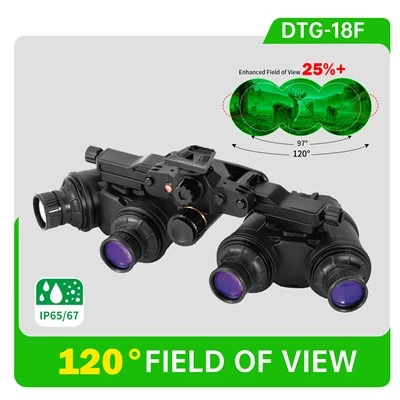
That’s not to say automatic gain control is useless—for casual users or very low-stakes situations, it’s fine. But for anyone relying on NVGs to navigate, hunt, or work in the dark, manual gain control is non-negotiable. Let’s look at our GPNVG-18 Night Vision Quad Goggles, a tactical-grade model used by military and law enforcement teams around the world. The GPNVG-18 has four separate image intensifier tubes, giving it an unprecedented 120-degree field of view (almost matching human vision, instead of the narrow 45-degree view of standard dual-tube NVGs). But that wide field of view means it’s more likely to pick up unexpected light sources across a broader area. A single glance at a distant streetlight could overload a quad-tube NVG with AGC, but manual gain control lets you adjust the amplification for the entire unit (or even individual tubes, on high-end models like our GPNVG 18 with Wide Field Sensor) to balance out dark corners and bright spots, keeping the entire image clear.
Let’s get practical, because I know you don’t want a bunch of tech jargon without real, actionable tips for using gain control. First, when to crank gain up: if you’re in a location with almost no ambient light—deep in a forest after midnight, out on a remote lake with no nearby towns, or in a rural field during a new moon—turn gain all the way up. This will make even the faintest light visible, letting you pick up small details like animal tracks, rocks on the ground, or distant landmarks. But pay attention to any signs of overamplification: if parts of the image start to look grainy, or you see bright halos around objects, that’s a sign gain is too high. Dial it back just a little until those halos and grain go away, but not so much that the image gets too dark.
When to turn gain down: this is the part most people mess up. Any time you’re near a light source—even a small one, like a headlamp on low, a campfire, or a phone screen—turn gain down immediately. If you don’t, that light will saturate the intensifier tube, leaving you with a blank white image for several seconds after you turn away, or even causing permanent damage to the tube over time. I once had a customer who brought back a pair of NVGs that looked like they had a permanent white spot in the center of the image—he’d forgotten to turn gain down while checking his phone’s GPS during a night hunt, and the bright phone screen burned a small spot on the intensifier tube. That’s avoidable with just a quick twist of the gain dial.
For specific use cases, let’s tie this back to our product lines, including our Night Vision Goggles For Hunting. Hunting at night is all about stealth and precision: you don’t want to scare off game with a bright light, but you also need to see clearly to take a safe, ethical shot. For hunting, we recommend setting gain to about 70-80% in total darkness—this gives you enough amplification to see deer or hogs moving through the trees, without overamplifying faint moonlight that could wash out small details like antlers or muscle movement. If you’re in an area with a half moon, turn gain down to 50-60%—the extra ambient light means you don’t need as much amplification, and a lower gain setting will give you a sharper, less grainy image, which is critical for identifying game vs. non-target species.
Our Infrared Night Vision Device For Outdoor Adventures is another great example of how gain control works in real life. Infrared (IR) NVGs use an additional IR illuminator to project invisible light onto objects, then pick up the reflected IR light to create an image. The gain control here works slightly differently, because you’re not just amplifying existing ambient light—you’re balancing the IR light you’re projecting. If you’re hiking on a trail with no moon, cranking up the IR illuminator (which is tied to gain on most of these models) will light up the path in front of you, but too much IR will make leaves and rocks look overexposed, making it hard to spot roots or uneven ground. Turning the IR gain down a bit keeps the image natural, so you can navigate without straining your eyes.
I’ve talked to a lot of customers who ask why some cheaper NVGs don’t have manual gain control, and why our mid-to-high-end models include it. The simple answer is that for casual, very low-light use (like walking to your car from a bar at night), automatic gain control works fine. But if you’re using NVGs for anything that matters—hunting, tactical operations, backcountry camping, search and rescue—manual gain control is non-negotiable. It gives you the flexibility to adapt to changing light conditions fast, without relying on a computer program that can’t anticipate every variable.
Another common question: does gain control affect the resolution of the image? Yes, to a small degree. When gain is set too high, the image intensifier tube starts to amplify not just light, but also electronic noise (static) from the tube itself. That’s why high gain settings often produce a grainy, noisy image, even if your NVG has a high-resolution sensor. Setting gain to the optimal level—high enough to get a bright image, but low enough to keep noise to a minimum—gives you the sharpest possible picture, whether you’re tracking a game animal or checking a trail for hazards.
Let’s also address a myth I hear all the time: “Higher gain means better night vision.” That’s simply not true. Better night vision comes from higher-quality image intensifier tubes, higher-resolution sensors, and better optical lenses. Gain control is just a tool to adjust how much amplification that tube or sensor is doing, based on the light around you. A mid-tier NVG with manual gain control will outperform a top-of-the-line model with automatic gain control in most real-world scenarios, because you can tailor the settings to exactly what you need at that moment.
At our company, we build all our NVGs with manual gain control for exactly that reason—we want our customers to have full control over their device, no matter what situation they’re in. Whether you’re choosing the Flip Side Up Design Night Vision Goggles for their versatility, the GPNVG-18 Night Vision Quad Goggles for their wide field of view, or our Infrared Night Vision Device For Outdoor Adventures for its rugged design, every one of our models is designed to give you the control you need to use night vision effectively.
If you’re in the market for NVGs, whether for hunting, outdoor recreation, or professional use, we offer a range of options to fit every need and budget. Our team of experts can help you choose the right model, explain how to adjust gain control for your specific use case, and walk you through any other features you need to know. We also provide detailed user guides for all our products, including step-by-step instructions for adjusting gain control, to make sure you feel confident using your NVG from the first time you take it out.
If you’re ready to learn more about our products, or want to discuss your specific night vision needs for hunting, outdoor adventures, or tactical use, reach out to our team to connect for procurement discussions. We’re here to help you find the right solution for you, so you can see clearly in even the darkest conditions.
References
- How Night Vision Works: Image Intensification and Thermal Imaging. Night Vision and Electronic Sensors Directorate, U.S. Army Research, Development, and Engineering Command.
- Gain Control Basics for Image Intensifier Tubes. Photonics Media, 2022.
- Optimal Gain Settings for Night Vision Goggles in Recreational and Professional Use. Outdoor Recreation Industry Tech Journal, 2023.
- GPNVG-18 Technical Specifications and Operational Use Cases. Tactical Gear Association, 2021.