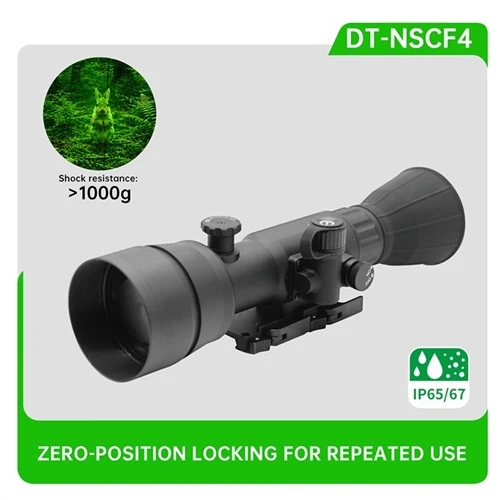
A night vision clip-on turns a rifle that already shoots well in daylight into a rifle that works after dark - without touching the day optic's zero. Mounted in front of the objective, it projects an intensified image into the day scope, so the shooter keeps the same reticle, the same cheek weld and the same trigger feel. The catch is that the device only delivers that convenience when the mounting interface, the collimation and the host magnification all stay inside their limits. This guide explains how a clip-on actually works, the six specifications that decide whether it will perform for you, and the setup steps that keep point of impact where it belongs.
Why a Clip-On Instead of a Second Dedicated Scope
The alternative is a dedicated night vision weapon sight, which means a second zero, a second dope card, a second mount and a second set of drills. A night vision clip-on avoids all of that. Because it sits forward of the objective, it does not change the day scope's turret settings, and one quality unit can serve several rifles if each host scope is fitted with the right interface.
For professional users the argument is stronger still. Patrol, wildlife management, border surveillance and pest control units typically need daylight capability and night capability from the same platform. A night vision clip-on lets an officer qualify in daylight, mount the device at dusk, and use identical holdovers after dark. Procurement teams also prefer it because one device can be shared across a team's rifles rather than doubling the optics inventory.
How a Night Vision Clip-On Works
Inside the tube, an objective lens focuses the faint scene onto a photocathode. Photons release electrons, the microchannel plate multiplies them, and a phosphor screen converts the electron cloud back into a visible image. That image leaves the rear eyepiece as a collimated bundle of light - which is why a night vision clip-on has to be optically aligned with the host scope's line of sight rather than simply bolted on.
Collimation is the alignment of that image axis with the host optic's axis. In practice it is adjusted with small windage and elevation screws on the clip-on body, verified by shooting, and checked again after any hard knock. A clip-on whose collimation is off will still produce a bright, sharp image - the shot simply lands somewhere other than where the reticle points.
Criterion 1: Day Optic Compatibility and Magnification Limits
Every night vision clip-on has a maximum host magnification. Common commercial limits sit between 4x and 6x. Above that limit the clip-on's exit pupil no longer fills the day scope's entrance pupil, so the image tunnels, vignettes or dims sharply. If you intend to clip a device in front of an 8x or 10x scope, confirm the manufacturer's stated limit in writing before ordering.
- Variable optics: a 1-6x LPVO works well - clip in at 4x or below. A 3-9x hunting scope is usually fine at its lower settings.
- Fixed high magnification: generally unsuitable for a clip-on unless the device is explicitly rated for it.
- Reticle type: etched and illuminated reticles both work; there is no need for a night-specific reticle.
- Objective size and coating: larger objectives give more light but also more weight forward of the rail, which changes balance.
Criterion 2: Eye Relief and the Mounting Interface
The clip-on is mounted forward of the day scope, which pushes the day scope further forward on the rail. That change matters more than most buyers expect, because eye relief and cheek weld shift with it. Plan the rail layout before purchase: many shooters need a cantilever mount or an extended rail to restore a comfortable head position.
The interface options in practice:
| Interface | Typical use | Notes |
|---|---|---|
| Quick-detach lever on the clip-on body | Picatinny rail in front of the day scope | Fastest removal; return-to-zero depends on lever tension |
| Dedicated objective adapter | Clamps to the day scope bell | Keeps the clip-on close to the optic; adapter is scope-specific |
| Throw-lever mount with recoil lug | Heavy-recoil rifles | Best zero retention, adds weight and cost |
Check three numbers before you buy: the rail space available forward of the day scope, the clip-on's mounting footprint, and the resulting total length. A night vision clip-on that cannot sit fully on the rail will not hold collimation under recoil.
Criterion 3: Zero Retention and Collimation Adjustment
Zero retention is the property that separates a serious clip-on from a hobby unit. Look for a mount with a recoil lug and a repeatable lever tension, and for collimation screws with fine, marked adjustment rather than free-turning screws that drift.
Field verification is straightforward. Zero the day scope in daylight, record the group, then clip the device on and shoot again from the same rest. A well-collimated unit should keep the shift small and repeatable; if the group moves, adjust collimation, then remove and refit the clip-on three or four times to confirm the shift holds. Any unit that changes point of impact every time it is refitted is a unit that will cause a missed shot.
Criterion 4: Generation, Gain and Resolution
Image intensifier performance comes down to a small set of numbers. Generation tells you the technology level; figure of merit combines resolution and signal-to-noise ratio into a single score that is far more useful for comparing two tubes.
| Parameter | Typical Gen 2+ | Typical Gen 3 |
|---|---|---|
| Resolution | 55–64 lp/mm | 64–72 lp/mm |
| Signal-to-noise ratio | 17–21 | 21–28 |
| Figure of merit | 1,200–1,600 | 1,600–2,200 |
| Gain | 20,000–40,000 | 40,000–80,000 |
| Tube life | 10,000 h typical | 10,000–15,000 h |
For a clip-on used on a rifle, resolution and SNR matter more than headline gain. High gain with mediocre SNR produces a bright but noisy image, and noise is what destroys target identification at distance. Ask for the tube data sheet: photocathode sensitivity, gain, SNR, resolution, halo and EBI are all testable values, and a supplier who cannot quote them is selling by photograph rather than by specification.
Criterion 5: Weight, Balance and Rail Setup
Weight forward of the receiver is the most underrated specification in the category. A 700 g to 900 g clip-on mounted ahead of the objective adds leverage that a shooter feels in offhand and barricade positions, and it can shift a light rifle's balance significantly.
Practical mitigations:
- Move the day scope back toward the shooter on a cantilever rail rather than accepting an awkward head position.
- Prefer a shorter, lighter clip-on if the mission is dismounted patrol; accept a heavier unit for vehicle or static work.
- Use a low-profile adapter to keep the centre of mass as close to the bore as possible.
- Confirm total length does not interfere with a suppressor or clip-on thermal device sharing the rail.
The clip-on adds capability, but it also changes how the rifle handles - and shooters who skip this step usually end up leaving the device in the case.
Criterion 6: Power, Environmental Rating and Legal Compliance
Field time is decided by battery life and sealing, not by the best-case image on a specification sheet. A single CR123A or AA cell typically gives 30 to 60 hours depending on gain setting, and devices that accept both are more forgiving in remote work.
- Sealing: IP67 or better against dust and immersion; look for MIL-STD-810G shock and vibration testing for a clip-on used on a firearm.
- Temperature range: −40 °C to +50 °C covers most professional deployments.
- Controls: gain and focus must be usable with gloves, ideally without tools.
- Compliance: night vision equipment is export-controlled in many jurisdictions and restricted for civilian ownership in some countries. Confirm the classification and end-user documentation before shipping a unit across a border.
Clip-On Night Vision vs Thermal Clip-On
Thermal clip-on systems detect heat and work in total darkness, through smoke, dust and light fog, which makes them excellent for detection. Image intensified night vision still wins on identification: reading a face, a uniform patch or a licence plate is a task a night vision clip-on does better in moonlight and near-infrared illumination.
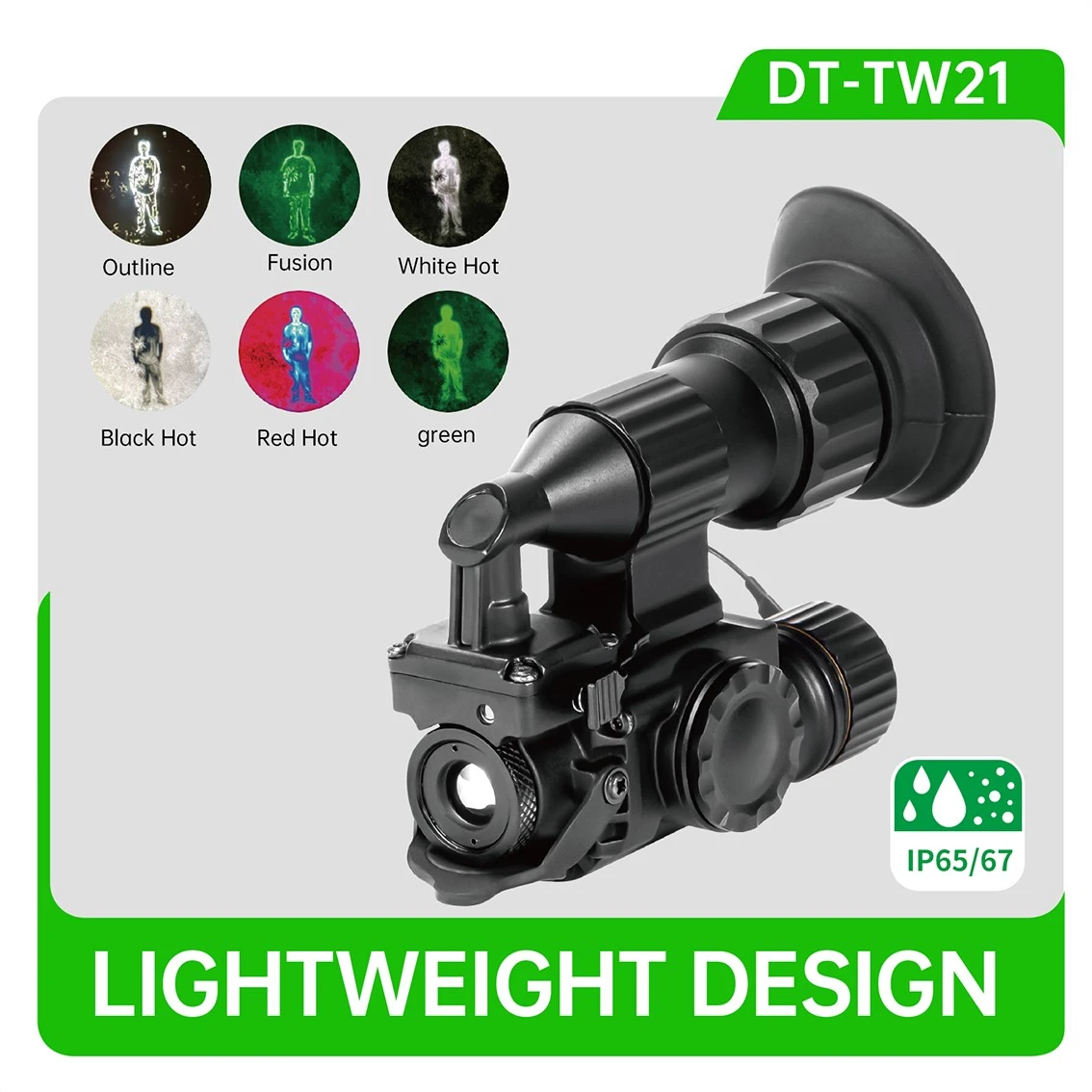
Many professional users now carry both and choose per task: thermal to find, intensified night vision to identify. Some systems go further and fuse the two channels into one image, giving the clip-on a thermal overlay that marks heat sources without hiding the intensified detail. If your mission includes both detection and identification, plan rail space and power for two devices from the start - retrofitting later is expensive.
Specification Checklist
Before you order a night vision clip-on, confirm every line below with the supplier in writing:
- Maximum host magnification in the day scope (4x–6x typical).
- Mounting interface and the exact rail footprint required.
- Stated point-of-impact shift and the collimation adjustment range.
- Tube data sheet: gain, SNR, resolution, FOM, halo, EBI.
- Weight and total length added forward of the rail.
- Battery type, runtime at usable gain, and low-battery indication.
- Sealing and shock standard (IP rating, MIL-STD-810G).
- Export classification and the documents supplied with the unit.
Common Mistakes Buyers Make
- Ignoring the magnification limit. Clipping a clip-on in front of a 9x scope and blaming the device for a dim, tunnelled image.
- Buying on generation number alone. A higher generation tube with poor SNR can look worse than a good Gen 2+ tube.
- Skipping the refit test. Collimation that only holds on the first mounting is not collimation.
- Underestimating weight. A heavy night vision clip-on changes the rifle's handling more than most shooters accept.
- Forgetting the rail plan. Adapters and cantilever mounts are part of the budget, not an afterthought.
- Overlooking export rules. Non-compliance on a clip-on is a legal problem, not a logistics problem.
FAQ
Q1: What magnification day scope can a night vision clip-on work with?
Most commercial and professional clip-on devices are rated for host scopes up to 4x or 6x. Above that limit the clip-on's exit pupil no longer matches the day scope's entrance pupil, so the image tunnels and dims. Check the manufacturer's stated maximum and stay inside it.
Q2: Does a clip-on change my day scope's zero?
No. Because a night vision clip-on sits forward of the objective and projects a collimated image into the day scope, the day optic's turrets and reticle zero are untouched. What can change is point of impact, and that is a function of collimation and mount repeatability, not of scope adjustment.
Q3: How often should I re-collimate?
Verify collimation after every hard knock, after changing hosts, and at the start of each season. A well-built night vision clip-on with a recoil-lugged mount usually holds for long periods; a unit that needs adjustment after every trip is telling you the mount or the collimation screws are the weak point.
Q4: Can I fit a night vision clip-on in front of a red dot or LPVO?
An LPVO at 1-4x is a good host and is one of the most common pairings. A red dot is workable on some units but offers no magnification, which limits identification distance. Either way, the mounting footprint and eye relief must be planned first.
Q5: Should I choose night vision or a thermal clip-on?
Choose thermal for detection - it works in total darkness and sees through smoke and dust. Choose a night vision clip-on for identification and detail, especially in moonlight or with near-infrared illumination. If your task requires both, budget for both, or look for a fused system.
Q6: How far can a clip-on see at night?
Under quarter moon with good atmospheric clarity, a Gen 3 clip-on can detect a human-sized target at several hundred metres, but recognition and identification distances are considerably shorter and depend on resolution, SNR and ambient light. Treat detection, recognition and identification distances separately in your requirements.
Q7: Are night vision clip-ons legal to buy and ship?
It depends on the jurisdiction. Night vision equipment is export-controlled in many countries, and civilian ownership is restricted in some. Confirm the export classification, the end-user documentation and any local licensing requirement before ordering a night vision clip-on for cross-border delivery.
Choosing a Night Vision Clip-On That Stays Zeroed
The specification sheet tells you what a device can do; the mount, the collimation and the rail plan decide whether it actually does it on your rifle. Work through the six criteria above, demand a tube data sheet, and test refit repeatability before you commit to a night vision clip-on for a whole team.
Shenzhen Detyl Optoelectronics builds night vision clip-on systems, thermal clip-on devices and fusion imaging systems for professional users, with tube data sheets, mount options and export documentation supplied on request. Send us your host scope, rail layout and mission profile, and our engineers will recommend a configuration and confirm the expected point-of-impact shift before you order.