What Is a Thermal Clip-On for Night Vision? How DT-TW21 Upgrades Your Night Vision System
一,Already Have Night Vision? Why Add Thermal?
A lot of operators already run a PVS-14, PVS-31, or a similar night vision monocular or binocular. The device works. The muscle memory is there. The mounts, batteries, and training pipeline are already in place.
Then the next requirement shows up: thermal.
That usually triggers a familiar question. If you want thermal imaging, do you have to retire the night vision system you already paid for and trained on?
Not necessarily.
A thermal clip-on sits in front of a compatible night vision device and adds heat detection to the system you already use. You keep the image-intensified picture for scene detail. You gain thermal contrast for targets that stand out by temperature, not by reflected light.
That is the point of the DT-TW21. It is not positioned as a replacement for night vision. It is a modular thermal attachment for people who already have a night vision system and want more information from it.
Instead of replacing your existing night vision device, a thermal clip-on can add thermal imaging capability to the system you already use.
二,What Is a Thermal Clip-On?
A thermal clip-on is a compact uncooled thermal module designed to mount on the front of a compatible night vision optic. In clip-on use, it is an upgrade path, not a second standalone viewer you have to swap in and out of the mission set.
That distinction matters. A standalone thermal monocular is a separate instrument. A clip-on is meant to sit on the night vision device you already wear or hold, so the user keeps the same head position, the same eye relief habit, and the same basic observation workflow.
三,How Does a Thermal Clip-On Work?
Night vision intensifies available light. Thermal imaging reads long-wave infrared radiation. A clip-on takes the thermal picture and puts that information into the existing optical path when it is mounted in front of the NV device.


On the DT-TW21, that clip-on role is one of three configurations. The same unit can also run as a handheld thermal monocular or a head-mounted thermal imager. In clip-on mode, the design priority is different: 1.0× magnification, a 32° field of view, and a 92 g body without battery, so the attachment does not fight the night vision system it is mounted to.
The user still looks through the night vision device they already know. The clip-on adds thermal information to that setup. It does not ask them to throw away the optic, the mount, or the way they already work at night.

四,Thermal Clip-On vs. Standalone Thermal Monocular
These two products answer different questions. A clip-on is for people who want to keep night vision and add thermal. A standalone monocular is for people who need a self-contained thermal viewer.
|
Feature |
Thermal Clip-On |
Standalone Thermal Monocular |
|
Existing NV compatibility |
Yes, on supported platforms |
Not required |
|
Upgrade an existing NV system |
Yes |
No |
|
Standalone operation |
Depends on the model |
Yes |
|
Modular installation |
Yes |
Limited |
|
Equipment replacement |
Usually not required |
Required if you are replacing NV |
Neither format is "better" in the abstract. If the user has no night vision and only needs heat signatures, a standalone thermal monocular is the simpler tool. If the user already owns a PVS-14, PVS-31, or a compatible Detyl platform and wants thermal without rebuilding the kit, a thermal clip-on is the more direct path.
五,Why Combine Thermal Imaging With Night Vision?
This is the part most product pages skip, and it is the reason buyers keep asking the same question: I already have night vision. Why do I still need thermal?
Because the two sensors do not see the same scene.
Night Vision and Thermal Imaging See the Environment Differently
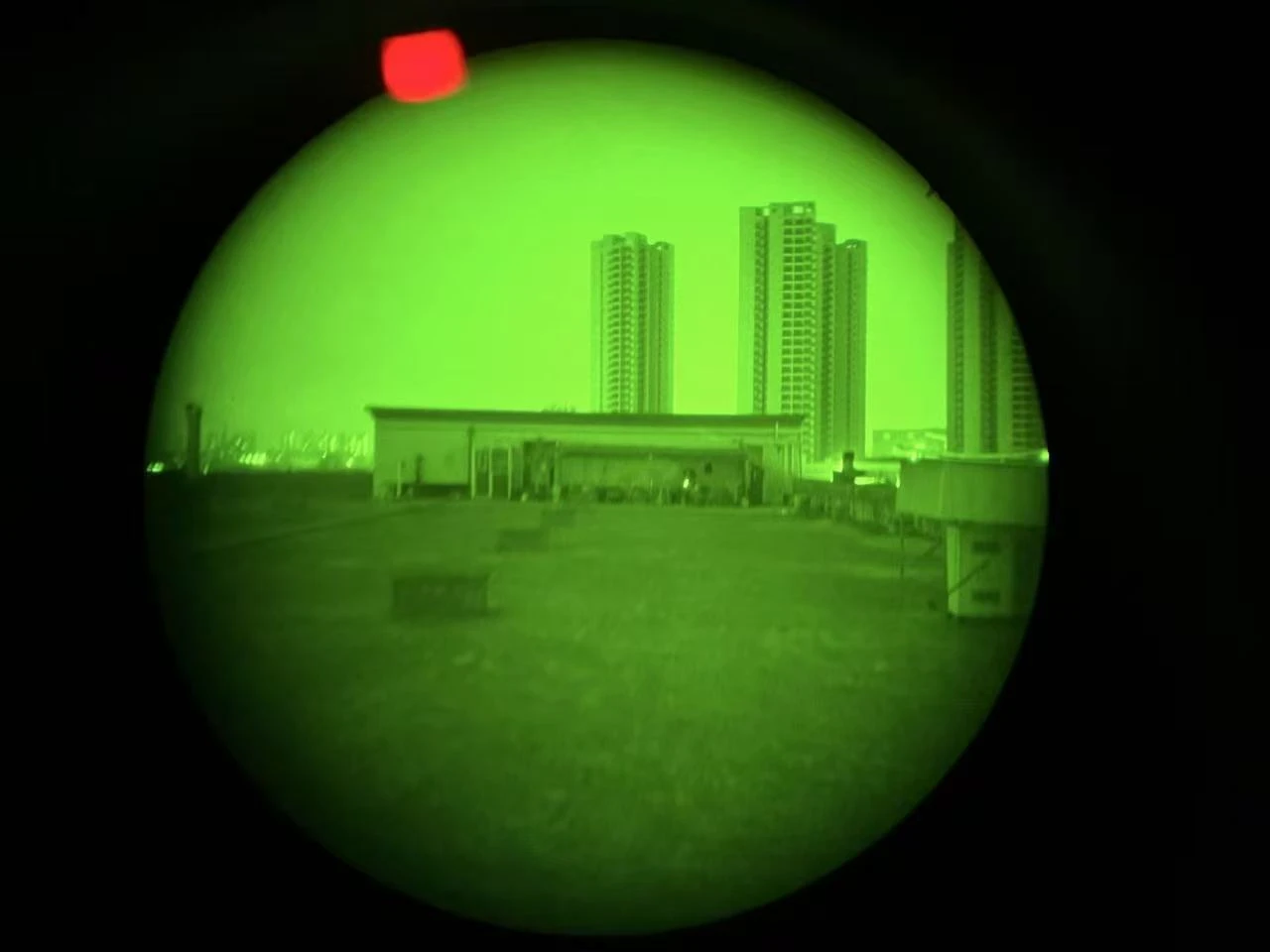
Night vision works with residual light: starlight, moonlight, sky glow, nearby artificial light. A good image intensifier gives you a continuous picture of the terrain. You can read shape, texture, vegetation, buildings, and movement against a familiar background. That is why night vision remains useful for navigation and for understanding where you are.
Thermal imaging does not need that light. It forms an image from infrared radiation in the long-wave band, typically 8–12 μm. Warm objects contrast against a cooler background. A person standing still in brush, a vehicle that has been running, or a heat source behind partial cover can show up even when there is almost no light to intensify.
Each method has a blind spot. Night vision can lose a low-contrast target in clutter, smoke, or total darkness with no usable photons. Thermal can find the heat source and still leave you short on natural scene detail. That is not a reason to pick one and discard the other. It is a reason to use both.
Why Thermal Can Complement Night Vision:
Night vision and thermal imaging are not competing technologies. They answer different parts of the same observation problem.
Night vision tells you what the environment looks like. Thermal tells you where the temperature difference is. Put together, the user gets more information from the same moment in the field:
- scene structure from the image intensifier
- heat contrast from the thermal detector
- a faster read on whether a shape in the dark is background or a target
The useful sentence is not "thermal replaces night vision." It is "night vision + thermal = more information."

六,What Is Night Vision Thermal Fusion?
Night vision thermal fusion is the practice of combining low-light intensified imagery with thermal imagery in one observation setup. The search terms people actually use are close variations of the same idea: night vision thermal fusion, thermal fusion night vision, thermal and night vision system.
In practical terms, fusion means the user is no longer forced to choose between a detailed night scene and a heat map. The two channels cover different failure modes. Low light, no light, clutter, and temperature contrast stop being separate problems handled by two different devices.
How the overlay is presented depends on the system. Some platforms fuse inside a purpose-built binocular. A thermal clip-on takes a different route: it attaches to a compatible night vision device the user already has and adds thermal capability at the front of that system.
That is the DT-TW21's role. It is a modular thermal attachment that can upgrade compatible night vision systems with thermal imaging, rather than a new goggle that replaces the current kit.

七,How DT-TW21 Upgrades Your Existing Night Vision System
You do not have to replace your night vision device to add thermal imaging.
That is the whole product argument. The DT-TW21 is built around an existing inventory of night vision devices, not around a clean-sheet purchase.
Keep Your Existing Night Vision Device
For a unit that already fields PVS-14s or PVS-31s, replacement cost is only part of the issue. There is also training, spare parts, helmet mounts, and the fact that the current devices still do their original job.
A clip-on leaves that stack in place. The night vision device stays the night vision device. Thermal becomes an add-on capability. That is a different buying decision from "scrap the monocular and issue a new thermal instead."
Add Thermal Imaging Capability
The DT-TW21 uses an uncooled long-wave infrared detector. The published core specs are straightforward:
- uncooled LWIR thermal detector
- 384 × 288 detector resolution
- 8–12 μm spectral band
- clip-on, handheld, and head-mounted configurations
In clip-on use, the thermal channel is there to extend the existing observation setup. The user is not being asked to learn a brand-new sight picture from scratch. They are adding heat information to a night vision system they already know how to run.

Designed for Multiple Night Vision Platforms
One attachment is only useful if it actually fits the devices already in the inventory. Detyl lists the DT-TW21 as compatible with:

PVS-31

PVS-14

NVG18

DTS31

DTS35

DTG18

DTNH921

DTS13
The list mixes common image-intensifier platforms with Detyl's own night vision line. For a procurement team, the relevant point is not the length of the list. It is that a single thermal module can cover more than one compatible goggle or monocular, instead of locking the upgrade to a single housing.
Confirm the exact interface and mount for the device you field before you assume drop-in fit. Compatibility on a spec sheet is the starting point, not a substitute for a fit check.
八,DT-TW21 Key Specifications Explained
Raw numbers only help if they map to a field decision. These are the clip-on figures that usually matter first.
384 × 288 Thermal Resolution
384 × 288 is the detector array. More pixels generally mean more thermal detail in the image, which helps when you are trying to separate a target from a busy background.
It is not a promise that every target will look sharp at every distance. Angular size, atmosphere, target-to-background temperature difference, and display mode all change what the user actually sees. Treat 384 × 288 as the sensor class, not as a guarantee of identification range.
32° Field of View in Clip-On Mode
In clip-on mode the DT-TW21 is specified at 32° FOV. That is a search field, not a sniper field. A wider view makes it easier to scan a street, a treeline, or a compound without constantly panning.
There is always a trade. Narrow FOV favors reach. Wide FOV favors awareness. Clip-on use on a night vision device is usually about finding and placing a heat source in the scene you already have, so a 32° field is consistent with that job.
1.0× Magnification in Clip-On Mode
Clip-on magnification is 1.0×. That is intentional. The attachment is supposed to sit in front of the existing night vision optic without turning the system into a separate magnified thermal sight.
If the goal were long-range thermal identification as a standalone optic, you would look at a different class of device. Here the job is fusion with the night vision system the user is already looking through.
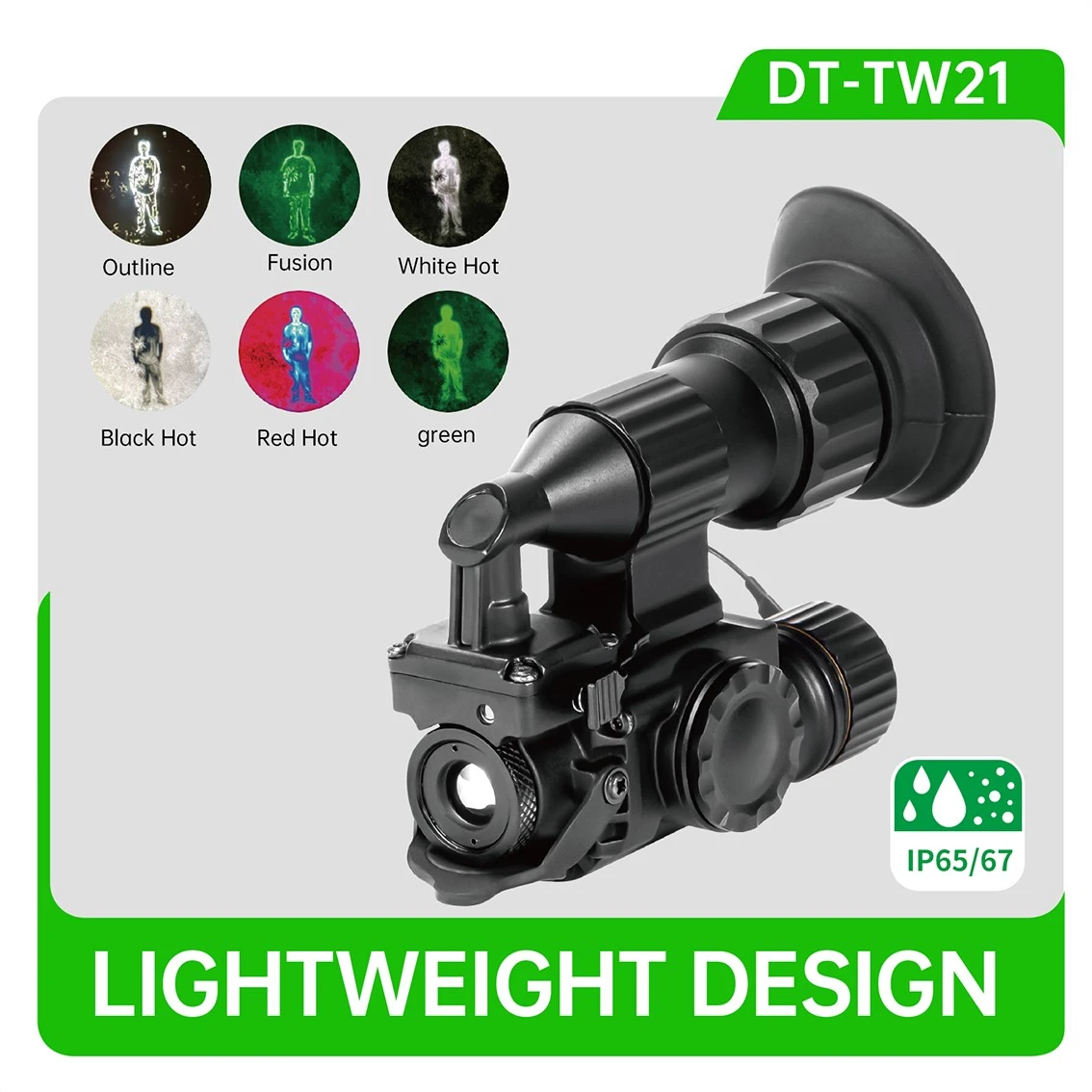
92 g Lightweight Clip-On Design
Weight is the spec most clip-on buyers feel immediately.
Published mass, battery excluded:
- clip-on: 92 g
- handheld: 140 g
- head-mounted: 144 g
Ninety-two grams on the front of a night vision device is still added mass. It is also far easier to justify than hanging a full standalone thermal monocular on the same mount. For helmet-borne systems, that difference shows up in neck fatigue and in whether the upgrade stays on the helmet or stays in the pouch.
九,How Far Can the DT-TW21 Detect a Human Target?
Range questions are the ones that show up in search. They also need the most careful wording.

Detection Range: Up to 450 m
Detyl-linked product data lists human-target detection at up to 450 m, using a 1.7 m human as the reference target.
Detection here means the operator can tell that a heat source of that general size is present. It does not automatically mean the operator can describe the target.
Recognition Range: Up to 350 m
The same data lists recognition at up to 350 m on the same 1.7 m human target.
Recognition is a higher bar than detection. The image has to carry enough structure for the user to classify what they are looking at, not only notice that something warm is there.
These figures are based on the manufacturer's specified test conditions and should not be treated as guaranteed real-world performance. Humidity, rain, target clothing, background temperature, concealment, and the user's display mode all move the number. Use 450 m / 350 m as a published reference, then validate against the environment you actually work in.

十,What Image Modes Does the DT-TW21 Offer?

White Hot

Black Hot

Green Hot

Red Hot

Outline
十一,When Should You Consider a Thermal Clip-On for Night Vision?
A thermal clip-on is not the default answer for every thermal requirement. It is the right answer for a specific buyer.
You Already Own a Night Vision Device
This is the primary audience. If there is no NV device in the kit, start with a standalone thermal or a purpose-built fusion goggle. If the NV device is already issued and trusted, clip-on becomes the cheaper systems decision.
You Want Thermal Capability Without Replacing Your NV System
Some teams do not have budget, time, or political room to recapitalize night vision. They still need heat detection. A clip-on is how you add the missing channel without opening a full replacement program.
You Need More Situational Awareness in Complex Environments
The combination is most useful when the scene is messy: low light, no light, mixed terrain, partial concealment, or a target that does not contrast well in intensified imagery but does contrast in temperature. Thermal does not magically solve every obscured target. It gives the observer another channel when reflected light is not enough.
You Prefer a Lightweight Modular Setup
If the night vision system is already close to its weight budget, a 92 g clip-on is a different conversation from adding another 300–500 g class monocular. Modular also means the thermal unit can come off and run handheld when the goggle is not needed.
Frequently Asked Questions About Thermal Clip-On for Night Vision
'lt is awesome to work with Creative. amazingy organized,easy to communicate with. responsive with next iterations,and beautiful work.
What is a thermal clip-on for night vision?
A thermal clip-on is a compact thermal module that mounts in front of a compatible night vision device. It adds heat detection to the existing NV system instead of replacing it.
Can a thermal clip-on replace a night vision device?
No. The two sensors do different work. Night vision uses residual light to show scene detail. Thermal uses infrared radiation to show temperature contrast. The DT-TW21 is built to add thermal capability, not to stand in for an image intensifier.
What is the detection range of the DT-TW21?
Up to 450 m on a 1.7 m human target, according to manufacturer-linked specifications. Treat this as a test-condition figure, not a guaranteed field distance.
What is the recognition range of the DT-TW21?
Up to 350 m on a 1.7 m human target under the same published conditions. Recognition is stricter than detection and will move with weather, background, and target contrast.
Conclusion: Upgrade Your Night Vision With Thermal Imaging
The default procurement reflex is still linear: need thermal, buy a new thermal device, or replace the night vision system.
The clip-on path is shorter. If the night vision device is already in service, add a thermal attachment. Keep the current optic. Keep the current training. Gain a heat channel.
That is the DT-TW21 argument in one line. It is a modular thermal clip-on for compatible night vision systems, light enough in clip-on mode to treat as an upgrade rather than a new platform.
Looking to add thermal imaging to an existing night vision system? Contact Detyl to confirm DT-TW21 compatibility with your platform, review the full specification set, and discuss configuration or customization options.