IR Illuminator vs Ambient Light: How Night Vision Works in Different Conditions
一,Why Does Night Vision Need Light?
"Night vision" is a slightly misleading name. Most people hear it and picture a device that lets you see in total blackness, no light required at all. That's not how a traditional image-intensifier night vision device actually works. It doesn't generate an image out of nothing - it needs some photons to work with, even if the amount is far below what the human eye can register.
Those photons can come from several places. Moonlight is the obvious one, but starlight, twilight glow, distant city lights, and scattered light bouncing off clouds or terrain all count too. A field that looks pitch black to your eyes may still be delivering a usable trickle of light to a night vision tube.
When that natural supply runs too low, an IR illuminator can fill the gap. It's a small device that emits infrared light - invisible to us, but perfectly usable by a night vision sensor - and effectively adds a second, artificial light source to the scene.
Put simply: ambient light is what's already there. An IR illuminator is what you bring with you.
That distinction raises the questions this article is built around: How much ambient light does a night vision device actually need? Can it work without any IR at all? When does adding IR actually help, and when does it not? And does more infrared always mean a better image? We'll go through each one.
二,How Does a Night Vision Device Work?
What Is Ambient Light?
Ambient light is any light already present in the environment before you introduce anything artificial. In the field, that typically means:
Moonlight
1
>>
Starlight
2
>>
Twilight (the glow before sunrise or after sunset)
3
>>
City or town lighting reflected off the sky
4
>>
Distant artificial light sources - vehicle lights, streetlights, security lighting
5
None of these need to look bright to be useful. A night vision tube is far more sensitive to low light levels than the human eye, so a scene that appears completely dark to you can still contain enough photons for the device to work with.
How Does an Image Intensifier Use Available Light?
The core process is straightforward, even if the electronics inside aren't:
Available light → objective lens → image intensifier tube → electron amplification → phosphor screen → visible image

Light enters through the objective lens and strikes a photocathode inside the intensifier tube, which converts photons into electrons. Those electrons are then accelerated and multiplied - this is the "intensifying" part - before striking a phosphor screen that converts them back into a visible image, usually in the familiar green or white-phosphor tone.
The important thing to understand is that a night vision device doesn't manufacture an image from nothing. It takes whatever light is already there and amplifies it, sometimes tens of thousands of times over. No input light means nothing to amplify.
What Happens When Ambient Light Is Very Low?
As available light drops, image quality drops with it. You'll typically see:
-
A darker overall image
-
Loss of fine detail
-
More visible noise or grain
-
Harder target recognition
-
Shorter effective detection range
This is exactly the point where an IR illuminator starts to matter. It doesn't fix a broken device - it simply adds back the light the environment isn't providing.
二,What Is an IR Illuminator?

What Does IR Illuminator Mean?
IR stands for infrared. An IR illuminator is an active device - it doesn't collect light, it emits it, in a wavelength band that sits just outside what the human eye can detect. A night vision device, on the other hand, is built to be sensitive to exactly that band, so it can pick up the infrared light the illuminator produces.
How Does an IR Illuminator Work?
The path is simple to describe:
IR illuminator → infrared light → target → reflected IR → night vision device → image
The illuminator shines infrared light out into the scene. That light hits objects - a person, a vehicle, terrain - and bounces back in the same way visible light does when it hits something in daylight. The night vision device picks up the reflected infrared and converts it into a visible image, following the same intensification process described above.

Why Can't We Usually See IR Light?
The human eye simply isn't built to register near-infrared wavelengths - our photoreceptors don't respond to that part of the spectrum. A night vision tube's photocathode does respond to it, which is precisely why the technology works: it can "see" a light source that's invisible to a person standing right next to it.
That's also why an IR illuminator isn't the same thing as a flashlight, even though both add light to a scene. A flashlight is visible to anyone nearby, night vision equipment or not. An IR illuminator's beam is invisible to the naked eye, and only becomes visible through a night vision or IR-sensitive device - a meaningful difference for anyone concerned with staying unseen.
IR Illuminator vs Ambient Light: What's the Difference?
This is the comparison most people are really asking about.
|
Feature |
Ambient Light |
IR Illuminator |
|
Source |
Natural / existing light |
Artificial IR light |
|
Availability |
Depends on the environment |
User controlled |
|
Moonlight |
Contributes |
Not applicable |
|
Starlight |
Contributes |
Not applicable |
|
Complete darkness |
Very limited |
Effective |
|
Control |
Limited |
Adjustable |
|
Extra equipment |
Not required |
Required |
|
Power required |
No |
Yes |
|
Stealth |
Passive |
Active |
Ambient Light
Advantages
- No extra equipment to carry or mount
- Doesn't draw on a battery
- Fully passive - nothing to detect
- Works naturally, without adjustment
Limitations
Depends on the weather
Depends on moon phase and cloud cover
Can't be turned up when you need more
Performance varies night to night, and hour to hour
IR Illuminator
Advantages
- Adds light exactly when and where the environment isn't providing enough
- Makes a real difference in very low-light conditions
- Can noticeably improve image brightness
- Many models offer adjustable output
Limitations
- Needs power and adds run-time considerations
- One more piece of equipment to carry, mount, and maintain
- Because it's an active emitter, it can potentially be picked up by anyone else equipped with night vision or IR detection gear
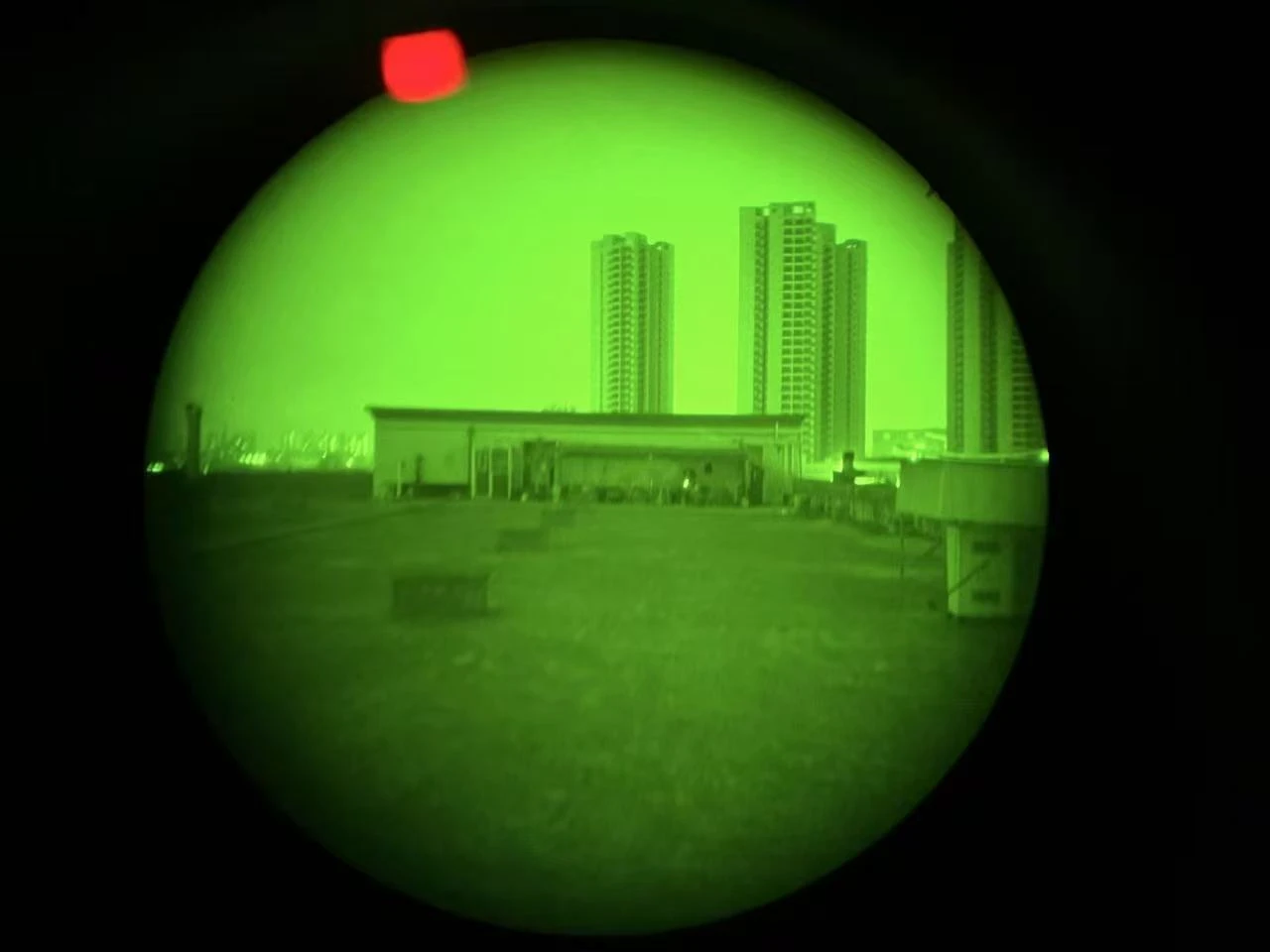
三,Can Night Vision Work Without an IR Illuminator?
The honest answer isn't a flat yes or no - it depends on where you are.
With Moonlight
In most cases, yes. A clear night with a decent moon phase provides enough ambient light for a good image intensifier to produce a clean, usable picture without any additional IR.
Under Starlight
Starlight alone is a much thinner light source, so results vary more. A high-performance tube can still deliver a workable image, but a lower-spec device may struggle - this is where tube quality starts to matter more than almost anything else.
In Urban Areas
Cities and towns rarely go fully dark. Street lighting, building lights, and vehicle headlights all contribute enough ambient light that running an IR illuminator continuously usually isn't necessary.
In Extremely Low-Light Conditions
Dense forest under heavy canopy, underground spaces, windowless rooms, and remote rural areas on a moonless, overcast night are a different story. In these environments, ambient light can drop close to zero, and an IR illuminator becomes genuinely useful rather than optional..
四,When Should You Use an IR Illuminator?
Outdoor Patrol
With reasonable ambient light - moonlight, starlight, or nearby artificial lighting - IR usually isn't necessary for basic observation.
Dense Forest
Tree canopy blocks moonlight from reaching the ground, even on a bright night. IR can noticeably improve visibility under cover.
Indoor / Dark Rooms
Interiors with little to no natural light are one of the clearest cases where IR illumination earns its keep.
Complete Darkness
This is the scenario IR illuminators are designed for - underground, enclosed, or fully shadowed spaces where there's effectively no ambient light to amplify.
Long-Distance Observation
Distance changes the calculation. IR power, beam angle, and focus all interact with how far a target is, and the relationship isn't linear - simply turning the power up doesn't guarantee a better result at range. We'll cover why in the next section.
五,How Does Night Vision Perform in Different Conditions?
Moonlight
Ambient light is relatively high, image quality is usually good on its own, and IR typically isn't needed.
Starlight
Ambient light is very low. Tube quality becomes the deciding factor, and IR can help.
Rain
Water droplets and reflections reduce visibility on their own. IR light can also scatter off nearby rain and create unwanted glare, so more IR isn't automatically better here.
Fog
Fog scatters light in every direction, which lowers contrast regardless of the light source. IR is not a universal fix for fog - in some cases it can make backscatter worse.
Dense Forest
Natural light is limited by canopy cover. IR can improve close- and medium-range visibility.
Indoor
Performance depends heavily on windows and any artificial lighting present. In genuinely dark rooms, IR is where most of the visible detail comes from.
|
Condition |
Ambient Light |
IR Need |
|
Full Moon |
High |
Low |
|
Starlight |
Low |
Medium |
|
Urban Area |
Medium |
Low |
|
Dense Forest |
Very Low |
Medium/High |
|
Dark Indoor |
Very Low |
High |
|
Complete Darkness |
None/Very Low |
High |
六,Does IR Illuminator Always Improve Night Vision?
Not automatically - and understanding why is part of using the equipment well.
More IR Does Not Always Mean a Better Image
Too much infrared output can overexpose the image, create hot spots on reflective surfaces, and throw off overall image balance. Atmospheric conditions and reflective terrain can also cut effective range shorter than the illuminator's rated distance would suggest. Output needs to match the scene, not just be maximized.
Beam Angle Matters
A wide beam spreads illumination across a broader area, which suits close-range or wide-area observation. A narrow beam concentrates the same output into a tighter zone, which suits observation at longer distances. Neither is universally better - it depends on the task.
IR Focus Matters
Some IR illuminators - the focus ring found on devices like the PVS-7 IR illuminator is a good example - let the user physically adjust the beam from a wide spread to a tighter, more concentrated pattern. That adjustability is often more useful in practice than raw power output, since it lets the beam match the actual working distance rather than illuminating far more area than needed.
七,IR Illuminator and Stealth: Is IR Invisible?

Can Other People See Your IR Illuminator?
To the naked eye, yes, it's invisible - that part is true. But "the human eye can't see it" doesn't mean "nothing can see it." Anyone equipped with their own night vision device, or any sensor sensitive to that part of the infrared spectrum, can potentially detect an active IR source, sometimes from a considerable distance. It's a real consideration for anyone whose position matters, which is why this distinction gets asked about so often by military and law enforcement users.
This is also where the concept of passive versus active observation comes in.
Passive: ambient light → night vision device
Active: IR illuminator → target → night vision device
Passive vs Active Night Vision
|
Passive Night Vision |
Active IR |
|
|
Light source |
Ambient light |
IR illuminator |
|
Additional light |
No |
Yes |
|
Equipment |
Simpler |
Requires an IR illuminator |
|
Power consumption |
Lower |
Higher |
|
Visibility to IR-sensitive equipment |
Lower |
Potentially detectable |
|
Low-light capability |
Depends on ambient light |
Improved with IR |
Neither mode is the "correct" one by default. The right choice depends on the environment and on what the mission or task actually requires - a patrol relying on moonlight in open terrain has very different needs than a team searching a windowless building.
八,How to Choose a Night Vision Device for Different Light Conditions
Urban / outdoor / moonlight
A high-quality image intensifier is often enough on its own.
Low-light forest
Look for a device that combines strong low-light performance with IR capability, since you may need both depending on canopy cover.
Indoor / extremely dark environments
IR illumination becomes a bigger part of the equation, not an optional add-on.
Professional / military use
Beyond IR, evaluate image intensifier performance directly: figure of merit (FOM), signal-to-noise ratio (SNR), and gain, along with IR illuminator output and adjustability, waterproofing, battery life, and helmet compatibility.
九,How to Choose an IR Illuminator
A handful of specifications determine how well an IR illuminator actually performs in the field:
- IR wavelength
- IR power
- Beam angle
- Adjustable focus
- Illumination distance
- Battery life
- Mounting method
- Weather resistance
One thing worth stating plainly: don't choose an IR illuminator based on maximum power alone. What actually matters in the field is real-world working distance, beam coverage, resulting image quality, and how long the unit runs on a charge - not the biggest number on the spec sheet.

FAQ

01.Does night vision need an IR illuminator?
02.Can night vision work in complete darkness?
03.Is IR illumination visible to the human eye?
04.What is the difference between an IR illuminator and an IR laser?
05.How far can an IR illuminator reach?
06.Does rain affect IR illumination?
Conclusion
Choosing the right night vision device depends on more than image quality on a spec sheet. Ambient light, IR capability, the operating environment, expected viewing distance, and mission requirements all affect how a device actually performs in the field.
Looking for a night vision device with integrated or adjustable IR illumination? Contact Detyl to discuss your application, required specifications, and configuration.