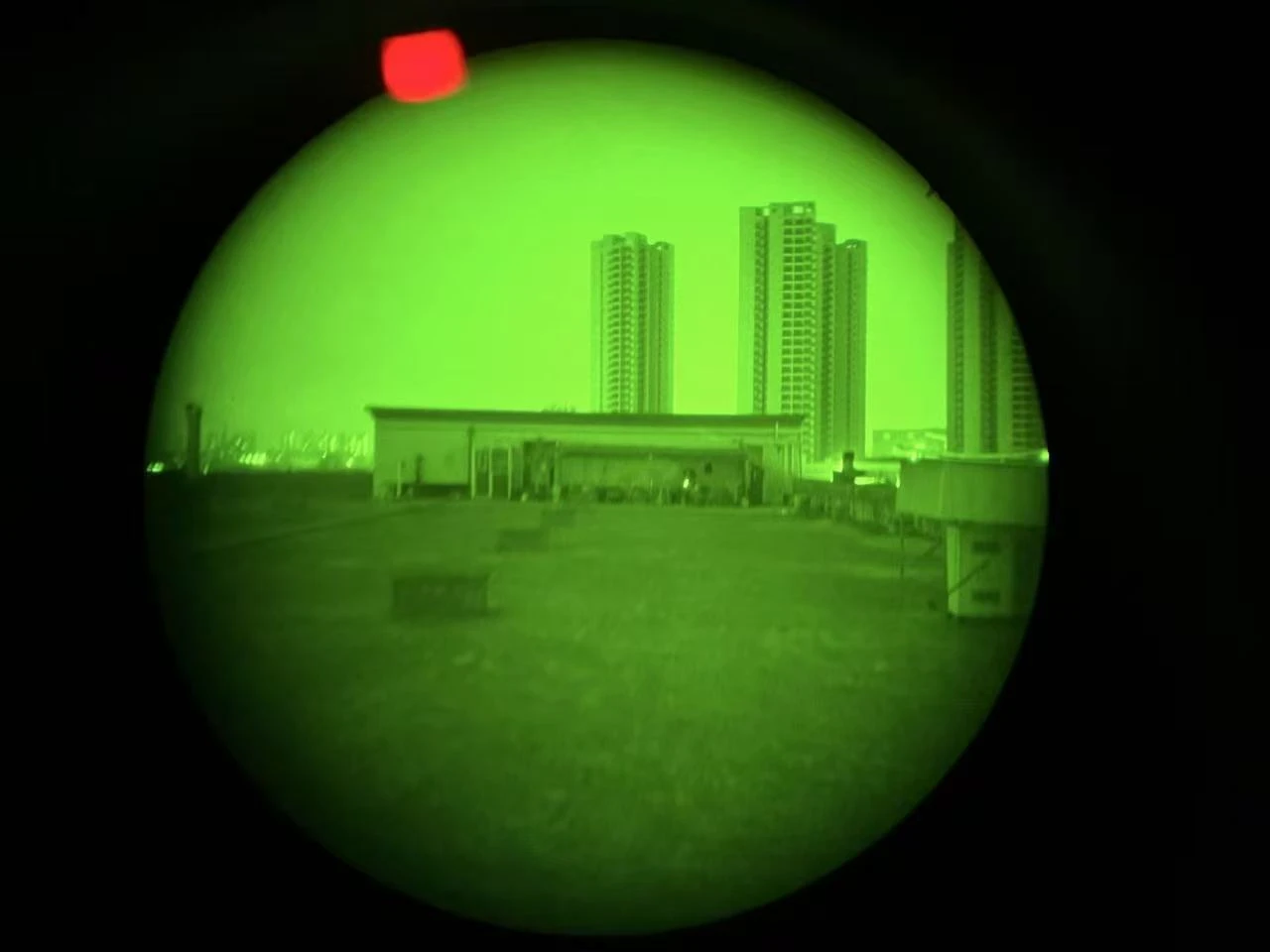
How Far Can a Night Vision Device See? Understanding Detection, Recognition and Identification Range
If you've spent any time shopping for night vision gear, you've probably run into the same frustration: every manufacturer lists a different "maximum range," and none of the numbers seem to agree. One brand claims 400 meters, another claims 600 meters for what looks like a similar spec sheet, and you're left wondering which one is telling the truth.
The honest answer is that there isn't a single "maximum distance" for any night vision device. Range depends on what you're trying to do with your eyes - spot that something is out there, figure out what it is, or make out fine detail. Those are three different tasks, and they happen at three different distances. In the optics and defense world, this is formalized as Detection, Recognition, and Identification (DRI), and understanding it is the single most useful thing you can do before buying - or specifying - a night vision device.
This guide walks through what detection, recognition, and identification range actually mean, what physically limits how far you can see at night, and how to read a spec sheet without getting misled by a big, bold number.
一,How Far Can a Night Vision Device See?
Typical Night Vision Viewing Range
Different categories of night vision equipment are built for different jobs, and their practical viewing ranges reflect that:
Night Vision Monoculars
typically usable for spotting a person-sized target from roughly 150–300 meters under moderate ambient light, though this varies widely by tube generation.
01
Night Vision Binoculars
similar optical range to monoculars, but the added depth perception makes it easier to judge distance and terrain, which effectively improves usable performance in the field.
02
Night Vision Goggles
generally optimized for wide field of view and mobility rather than raw distance, since they're built for navigation and situational awareness at closer range.
03
Night Vision Rifle Scopes
often paired with magnification and larger objective lenses, pushing detection ranges out to 400 meters or more in good conditions.
04
Digital Night Vision
ranges vary the most in this category, since performance depends heavily on sensor size and built-in IR output rather than a traditional image intensifier tube.
05
The point worth remembering here: "viewing distance" is not the same thing as "the distance at which you can clearly make out what you're looking at." A device can technically show you something at 500 meters while only letting you confirm what that something actually is much closer.
Why There Is No Single Standard Night Vision Range:
You'll rarely see a manufacturer say something as simple as "this device can see 500 meters" and have that statement mean much on its own. Real-world range is the product of several variables stacking on top of each other:
-
Image intensifier tube performance
-
Objective lens diameter and speed
-
Magnification level
-
Ambient light available in the scene
-
Size of the target itself
-
Weather conditions
-
Presence and strength of IR illumination
-
Overall optical quality
-
Resolution and image clarity
Change any one of these and the "range" changes with it. That's why two devices with nearly identical published numbers can perform very differently once they're actually in the field.

二,Understanding Detection, Recognition and Identification (DRI)
This is the framework that makes sense of all those conflicting range numbers, and it's worth sitting with for a moment.
|
Term |
Meaning |
Example |
|
Detection |
You can tell something is there |
You notice a shape or movement in the distance |
|
Recognition |
You can tell what category the object belongs to |
You determine it's a person, not a deer or a vehicle |
|
Identification |
You can make out specific details |
You can tell what the person is wearing or carrying |
What Is Detection Range?
Detection answers one question: can you tell that something is there at all?
At detection range, you might notice movement, a silhouette, or a human-sized shape against the background - but you won't be able to say much more than "there's something out there." This is normally the longest of the three ranges, because it only requires the eye (or sensor) to register a difference from the background, not to resolve any detail. It's driven largely by target size and how much contrast the target has against its surroundings.


What Is Recognition Range?
Recognition answers a more specific question: can you tell what kind of object this is?
At this distance you can generally sort a target into a broad category - person, vehicle, animal, structure - even if you can't see fine detail. Recognition range is shorter than detection range, sometimes noticeably so, because your eye now needs enough resolved detail to distinguish shape and outline rather than just contrast against the background.
What Is Identification Range?
Identification is the most demanding of the three: can you make out specific characteristics of the target?
This might mean seeing what type of clothing a person is wearing, whether they're carrying equipment, or what specific type of vehicle you're looking at. Identification range is almost always the shortest of the three distances, because it requires the most resolved detail and the least room for ambiguity.

三,Detection vs Recognition vs Identification: What's the Difference?

A simple way to picture the relationship:
500 m → Detection - you can tell something is there
300 m → Recognition - you can tell it's a person
150 m → Identification - you can tell what they're wearing or carrying
These numbers are illustrative only - actual distances vary by device specification, target size, and environmental conditions. Don't treat any example figures, from this article or a product page, as a guaranteed standard. Treat DRI as a way of thinking about range, not a fixed formula.
四,What Factors Affect Night Vision Detection Range?
Image Intensifier Tube Performance
The heart of any traditional night vision device is its image intensifier tube, and its specs matter more than almost anything else on the spec sheet:
-
Resolution (line pairs per millimeter)
-
Signal-to-noise ratio (SNR)
-
Figure of Merit (FOM)
-
Gain
-
Equivalent Background Illumination (EBI)
-
Photocathode sensitivity
Generally speaking, a higher-spec tube delivers a clearer, brighter image in low light. But the tube doesn't work in isolation - actual range still depends on the rest of the optical system and the conditions you're using it in. A great tube behind a mediocre lens won't perform the way the tube's datasheet suggests.

The objective lens determines how much light actually reaches the tube in the first place. Key factors include lens diameter, f-number, light-gathering capability, and optical transmission.
Compare an f/1.2 objective to an f/1.7 objective as an example: the faster lens (lower f-number) lets in significantly more light, which matters enormously in low-light or moonless conditions where every photon counts. Two devices with identical tubes can still perform very differently depending on the lens sitting in front of that tube.
Magnification is one of the most misunderstood specs in night vision. Whether you're looking at a 1× device or one with a 3×, 4×, or 5× magnifier, higher magnification makes distant objects appear larger - but it does not automatically improve image quality or extend detection range.
In fact, cranking up magnification without a corresponding increase in light-gathering capability can actually make the image dimmer and grainier, since the same amount of light is now spread across a larger apparent image. Magnification changes how big a target looks, not how much information the device is actually capturing.
This is arguably the single biggest real-world variable. Traditional night vision doesn't create light out of nothing - the image intensifier tube needs some photons to work with, whether from moonlight, starlight, distant urban glow, twilight, or reflected light off clouds.
A clear night with a bright moon and a heavily overcast, moonless night can produce dramatically different results from the exact same device. This is why a single "maximum range" figure is almost always measured under a specific, favorable set of lighting conditions that may not match your actual environment.
In near-total darkness, an infrared (IR) illuminator becomes essential. It supplements the scene with IR light that the tube or sensor can pick up even when there's no usable ambient light at all. Common wavelengths are 850 nm and 940 nm, with 940 nm being less visible to the naked eye (including other people's night vision) at the cost of somewhat reduced range compared to 850 nm.
IR illumination can meaningfully improve visibility and effective detection range, but how much it helps depends on the illuminator's power output, beam angle, how reflective the target is, and the surrounding environment. An IR illuminator isn't a universal fix - it has its own falloff with distance, just like visible light.
Fog, rain, snow, dust, and high humidity all degrade night vision performance, and the mechanism is straightforward: these conditions scatter and absorb light, which reduces contrast. Lower contrast means lower image quality, and lower image quality directly shrinks both detection and recognition range. A device that performs well on a clear, dry night can lose a substantial portion of its effective range in fog or heavy rain.
This factor gets overlooked constantly, but it matters as much as the hardware itself. A large vehicle is typically detectable at a much greater distance than a small human target, simply because it presents a bigger, easier-to-resolve silhouette.
Target size, background composition, contrast against the surroundings, and even whether the target is moving all affect how far away you can realistically spot, recognize, or identify it. Two identical devices pointed at different targets in different settings will report very different effective ranges - which is exactly why raw spec numbers only tell part of the story.
五,Night Vision Range in Complete Darkness
What Happens When There Is Almost No Ambient Light?
A common question buyers ask is whether night vision works in total darkness. The honest answer: a traditional image intensifier tube cannot amplify light that isn't there. It needs some photons to work with, even if that amount is extremely small. In near-zero ambient light, image quality drops noticeably, and detection, recognition, and identification ranges all shrink accordingly.
How IR Illumination Help
This is where the distinction matters:
- With some ambient light present, the device operates in standard low-light mode, amplifying whatever's available.
- With effectively no usable light, the device shifts to IR-assisted operation, relying on its own infrared illuminator (or an external one) to actively light the scene in a spectrum the tube or sensor can pick up.
In other words, "complete darkness" performance is really a question of IR illuminator strength and range, not the image intensifier tube's raw amplification ability.
六,How to Test Night Vision Detection, Recognition and Identification Range

Standardized Test Conditions
Meaningful DRI testing requires tight control over a long list of variables: target size and type, test distance, ambient illumination level, weather conditions, lens specification, tube specification, and whether IR illumination is on or off. Change any one of these and the resulting range figures change too.
Why Manufacturer Range Data May Differ
This is exactly why range specs vary so much between brands, even for devices with similar-looking hardware. Different manufacturers may test against different target sizes, in different environments, under different lighting conditions, and even use different working definitions of what counts as "detection" in the first place.
The practical takeaway: don't compare published range numbers across brands unless you can also compare the test conditions behind them. A 500-meter detection range tested against a vehicle in bright moonlight isn't comparable to a 500-meter figure tested against a person on an overcast night.

七,How to Read Night Vision Range Specifications
Once you understand DRI, spec sheets start to make a lot more sense. Take an example listing:
Detection Range: 450 m
Recognition Range: 350 m
This doesn't mean you can clearly see a person's face at 450 meters. It means:
At 450 m, you can detect that a target is present.
At 350 m, you can recognize what type of target it is.
Identification range - being able to make out specific details - is typically shorter still, and often isn't listed at all.
Whatever numbers are printed on the box, actual field performance will still depend on ambient light, weather, and target characteristics on the night you're actually using the device. Treat spec sheet ranges as a reference point, not a guarantee.
八,Night Vision Range vs Thermal Imaging Range
Night vision and thermal imaging solve the "seeing in the dark" problem in fundamentally different ways, and it's worth knowing the difference before choosing between them.
|
Feature |
Night Vision |
Thermal Imaging |
|
Main principle |
Amplifies available light |
Detects thermal radiation |
|
Low-light performance |
Excellent |
Excellent |
|
Complete darkness |
Usually needs IR |
Works natively |
|
Target recognition |
Strong |
Strong |
|
Heat signature detection |
No |
Yes |
|
Detail / visual information |
Excellent for fine visual detail |
Different type of information (heat contrast, not visual texture) |
Night vision gives you a more natural, visually detailed image - useful when recognizing specific visual features matters. Thermal imaging detects heat differences regardless of ambient light or camouflage, which makes it excellent for spotting warm bodies against a cool background, even through light foliage or smoke. Neither is strictly "better" - they answer slightly different questions, which is a topic worth its own deep dive if you're deciding between the two.
九,How to Choose a Night Vision Device Based on Viewing Distance
Personal Observation
For general outdoor use, hiking, or casual observation, prioritize a lightweight device with 1× magnification and easy portability over raw maximum range. You'll rarely need to identify fine detail at long distance for this kind of use.
01
Military and Law Enforcement
Here, detection range, recognition range, and true identification capability all matter, often at the same time. Add helmet-mounting compatibility and rugged durability to the list, since these devices need to perform reliably under demanding field conditions.
02
Security and Surveillance
Long observation distance, strong IR capability, high optical performance, and the ability to run continuously for extended shifts are the priorities. Detection and recognition range matter more here than close-range identification detail, since the goal is usually early awareness over a wide perimeter.
03
Search and Rescue
Strong low-light performance, a wide field of view, reliable target detection, and adaptability across varied environments and weather matter most. In this use case, spotting something quickly across a broad area often outweighs the ability to identify fine detail at maximum range.
04
Frequently Asked Questions
Lorem ipsum dolor sit amet,consectetur.
How far can a night vision device see?
+
-
It depends entirely on the task. A device might detect a target's presence at several hundred meters, recognize what type of target it is at a shorter distance, and only let you identify fine detail at a much closer range. There is no single "maximum distance" figure that applies to all three.
What is the difference between detection and recognition range?
+
-
Detection range is the distance at which you can tell something is present. Recognition range is the shorter distance at which you can tell what category that object belongs to - for example, a person versus a vehicle.
What is identification range in night vision?
+
-
Identification range is the distance at which you can make out specific details about a target, such as clothing, equipment, or other distinguishing features. It's typically the shortest of the three DRI ranges.
Does higher FOM mean longer viewing distance?
+
-
A higher Figure of Merit generally indicates better tube performance and image quality in low light, which can support longer effective range. But FOM alone doesn't determine range - lens quality, magnification, and environmental conditions all play a role too.
Does an IR illuminator increase night vision range?
+
-
Yes, particularly in low or no ambient light. The actual improvement depends on the illuminator's power, beam angle, target reflectivity, and surrounding conditions.
Conclusion
Three things are worth carrying away from all of this:
- Detection, recognition, and identification are not the same distance. A single "range" number on a spec sheet is almost always describing just one of the three, usually the longest one.
- Actual viewing distance is the product of the tube, the optical system, the environment, and the target itself - not any single spec in isolation.
- A "Maximum Range" figure alone isn't enough to judge a device. It's a starting point for comparison, not the whole story.
When evaluating a night vision device, look past the headline number. Compare tube specifications, optical system quality, detection and recognition performance, and - where available - the test conditions those numbers were measured under. That comparison will tell you far more about how the device will actually perform in your hands than any single distance figure ever could.