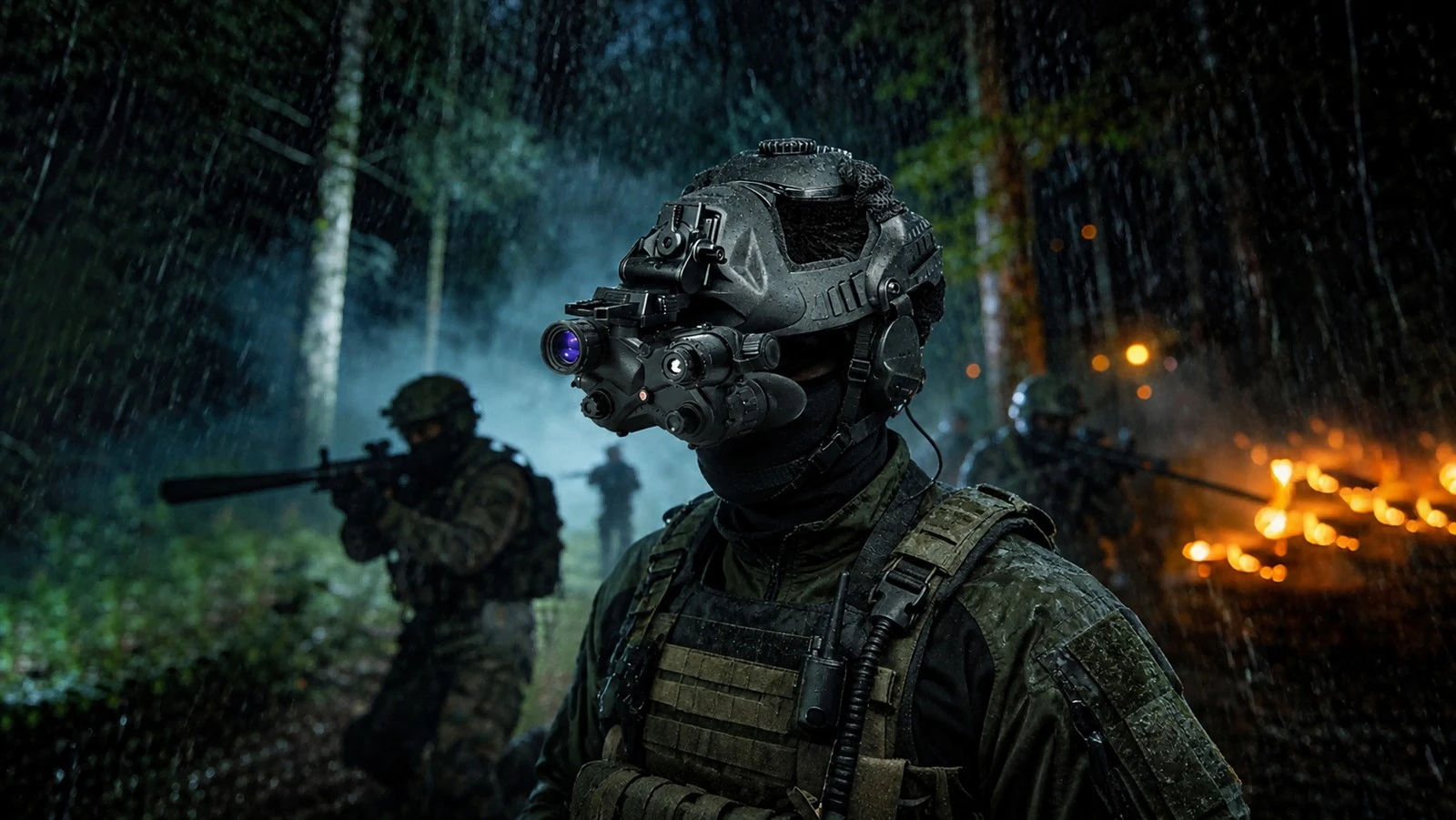
Picture a rescue team entering a smoke-choked building at 02:00. Their standard Gen3 goggles are blind - the smoke scatters the ambient light the intensifier needs. Their thermal monocular detects a body signature, but the image is too coarse to navigate safely around structural debris. With the DTS-23T Thermal Fusion Night Vision Goggles, both problems disappear: the thermal channel cuts through smoke to pinpoint heat, while the simultaneous intensifier feed renders the rubble in sharp, navigable detail. That convergence - delivered in a single fused frame, with no switching, no dead time - is precisely what Detyl Optoelectronics set out to engineer.
The DTS-23T is built on Detyl's proprietary Dual-Channel Adaptive Fusion (DCAF) algorithm, developed over four years of iterative field testing with security professionals across six countries. DCAF dynamically weights the contribution of each sensor based on scene conditions: in near-total darkness it amplifies the thermal overlay; as ambient light increases it blends in more intensifier detail - all in real time, at 50 Hz, without operator intervention. The result is a hybrid night vision goggle that adapts to the environment rather than forcing the operator to adapt to the device.
Built for the Mission. Verified in the Field.
During a counter-narcotics operation in dense jungle terrain, a tactical team reported that the DTS-23T's fusion mode detected two concealed individuals at 180 m through undergrowth that completely blocked their previous Gen3-only devices - with enough image detail to confirm non-combatant status before engagement. In a mountain search-and-rescue exercise conducted at −15°C, operators located a simulated casualty in thermal-only mode within 22 seconds across open snowfield, then seamlessly transitioned to fusion mode to navigate safely across a rocky descent - without removing the goggles or pressing a single menu button. These are not edge cases; they are the baseline requirement the DTS-23T was designed to meet.
2. Sub-Pixel Co-Registration Calibration
Sensor fusion is only as good as its alignment. The DTS-23T undergoes a factory sub-pixel co-registration calibration process in which the thermal and intensifier channels are geometrically aligned to within 0.1 pixel across the full 50° field of view.
3. Industry-Leading 50° Ultra-Wide Field of View
Most helmet-mounted binoculars ship with a 38–42° FOV. The DTS-23T's ≥50° FOV - achievable because Detyl's custom eyepiece design extends the optical exit pupil without increasing weight - translates to roughly 30–32% more scene area per glance compared to standard units. In practical terms during building clearance, Over a four-hour operation, that difference is measured in fatigue, reaction time, and tactical advantage.
420 g Wearable Form Factor - All-Day Operational Endurance
the DTS-23T is closer in weight to a conventional Gen3 monocular than to a full thermal-fusion binocular. Helmet-mounted, that difference in neck-load is clinically significant on operations lasting more than two hours. The adjustable interpupillary distance (IPD) and variable diopter eyepieces ensure the unit fits correctly out of the box for the vast majority of operators without tools or additional parts.
IP65 / IP67 - Sealed for Operational Reality
The DTS-23T is independently rated to both IP65 (sustained water jet, 12.5 mm nozzle) and IP67 (1 m submersion for 30 minutes). Detyl applies MIL-grade O-ring sealing and conformal coating to every internal PCB before assembly - not as an option, but as a production standard. The unit has been deployed in equatorial rainfall, North Sea maritime surveillance, and high-desert dust environments without sealed seal failure. Operators do not need a weather assessment before gearing up; the DTS-23T is ready regardless.
Why choose Detyl
Here Are Four Reasons Why You Choose Us
1. Detyl DCAF™ Exclusive Thermal Fusion Algorithm
At the heart of the DTS-23T is the Dual-Channel Adaptive Fusion (DCAF™) engine - Detyl Optoelectronics' most significant R&D investment to date. Unlike simpler overlay approaches that statically blend two feeds at a fixed opacity ratio, DCAF performs per-frame scene analysis, dynamically allocating sensor weight based on thermal contrast, ambient photon density, and edge-feature detection. The practical outcome: operators see a fused image that is consistently more readable than either channel alone, regardless of whether they are in a lit urban street, a pitch-black cave, or a smoke-filled structure. Competing Gen3 thermal overlay goggles relying on fixed-blend firmware cannot match this level of scene-adaptive intelligence.
Applications & Operational Scenario Guide
Night entries, hostage recovery, and urban surveillance all share a common demand: the ability to detect threats faster than the threat detects you. The DTS-23T's Fusion mode handles this directly - body heat registers through interior walls in thermal-only mode, while the simultaneous intensifier layer allows operators to read room geometry, identify bystanders, and coordinate safe movement. The 50° FOV provides roughly 30% more scene coverage per head position compared with 40°-class competitors, reducing the number of scan cycles needed during a dynamic breach. Units currently serve with enforcement agencies across Southeast Asia, the Middle East, and Eastern Europe in roles ranging from counter-terrorism to border interdiction.

Search & Rescue - Finding People When Time Runs Out
In a post-earthquake rubble search at night, conventional tools fail in sequence: lights attract panic; thermal monoculars find signatures but can't guide footing; Gen3 goggles navigate fine but miss buried survivors. The DTS-23T resolves the trilemma. Rescuers work in fusion mode - thermal detects a 37°C heat signature through 30 cm of concrete debris while the intensifier feed renders the surface terrain for safe approach. In a documented exercise with a SAR team in Northern Europe, the DTS-23T reduced mean victim-location time from 4.5 minutes (single-sensor) to under 90 seconds - a difference that is measured in survival probability in real incidents.


Critical Infrastructure & Long-Perimeter Security
Energy facilities, ports, border corridors, and airfields share a challenge: long perimeters that must be monitored continuously through the night, in all weather. The DTS-23T's 8-hour extended battery runtime means a single operator can complete a full night shift without a battery swap. Thermal mode at 640×480 resolution and 50 Hz provides smooth, high-resolution detection of crossing attempts through foliage, camouflage netting, or low-reflectance surfaces that defeat CCTV and radar alike. IP67 sealing ensures operation through coastal fog, monsoon rain, and blowing sand - conditions that frequently force less-protected optics offline.
Military Reconnaissance & Vehicle-Mounted Integration
Beyond dismounted use, the DTS-23T supports OEM integration into vehicle sighting systems, drone payloads, and fixed surveillance towers via Detyl's open video output interface. The 50 Hz thermal frame rate is compatible with standard video recording and transmission systems, enabling real-time relay to command. Reconnaissance units value the 1× unity magnification for rapid wide-area scanning, with the option of pairing the DTS-23T with dedicated spotting scopes for long-range positive identification. Detyl's engineering team provides full integration documentation and custom firmware support for institutional OEM partners.


Wildlife Research, Ecological Survey & Expedition Use
For researchers conducting nocturnal population surveys, behavioral observation, or anti-poaching patrols across large territories, the DTS-23T offers a capability profile previously available only in laboratory-grade equipment. At 420 g, it is light enough for multi-day pack-in expeditions; at IP65, it handles river crossings and tropical rain. Thermal mode allows rapid census of heat-signature animals across open ground at distances where conventional image intensifiers produce only shadow, while fusion mode delivers the species-level visual detail that researchers need to log meaningful observations.

Common Problem
What exactly is a thermal fusion night vision goggle, and why does it matter operationally?
A thermal fusion night vision goggle merges two physically distinct imaging modalities - image intensification (II), which amplifies photons from ambient starlight or moonlight, and thermal imaging (TI), which maps surface infrared emission regardless of available light - into a single composite view. The strategic value: II provides the fine-detail scene rendering operators need to navigate and identify; TI finds targets that are actively concealed from, or simply invisible to, photon-dependent systems. Fused together, they cover each other's failure modes. An operator using the DTS-23T does not choose between seeing detail and seeing heat - they see both, in the same frame, at the same time.
How specifically does the DTS-23T outperform a pure thermal monocular or standard Gen3 NVD?
A standalone thermal monocular resolves heat but not detail: at standard LWIR resolutions, two people standing 1.5 m apart at 80 m are often indistinguishable blobs. A Gen3 NVD resolves detail but requires photons: in a zero-lux environment or through smoke, it simply stops working. The DTS-23T's DCAF™ algorithm dynamically blends both signals, so the operator always receives the maximum available information. For organizations currently issuing both a thermal monocular and a Gen3 NVD per operator - at combined weights of 600–900 g and purchase costs of two separate procurement lines - the DTS-23T consolidates both into a single, lighter, cheaper-per-capability unit.
What is the pricing structure, and is OEM / volume procurement supported?
DTS-23T unit pricing reflects professional Gen2+/Gen3 intensifier tube sourcing, the DCAF™ firmware license, and Detyl's factory-direct supply model - with no distributor margin added for direct institutional accounts. Volume pricing tiers begin at quantities of 10 units. Full OEM/ODM support is available for organizations requiring custom branding, modified firmware, alternative display configurations, or system integration with existing C2 platforms. Lead times and NRE costs for OEM programs are disclosed at the MOU stage. Contact Detyl's technical sales team with your quantity, delivery timeline, and specification requirements for a formal quotation within 48 hours.
What warranty and in-service support does Detyl Optoelectronics provide?
All DTS-23T units ship with a 24-month manufacturer's warranty covering defects in materials, workmanship, and firmware - including the DCAF™ fusion engine. OEM and institutional partners are offered extended service agreements that include priority return-to-manufacturer (RMA) with a 10-business-day turnaround commitment, on-site calibration verification at annual intervals, and access to Detyl's engineering team for mission-specific configuration support. Warranty does not cover damage from unauthorized disassembly, ordnance effects, or use outside the rated environmental envelope. Full terms are provided with each purchase agreement.