Hey everyone, it’s Jake from AB’s Night Vision Gear here, and let’s cut to the chase—one of the most common questions I get from hunters, security teams, outdoor hikers, and even curious home owners is: do night vision goggles actually work when it’s total darkness? Like, no moonlight, no starlight, no random street glow—pitch black, the kind that makes you squint and still see nothing kind of dark. I’ve had people argue with me about this for years, like they’ve seen a TikTok of someone “proving” night vision is fake, or they’ve spent a night in the woods and couldn’t make their old $20 Amazon goggles do squat. Let’s break this down the real way, no hype, no fluff, just the science that I’ve tested out with our gear for years.
First, let’s get one basic fact straight: not all night vision is the same. That’s a big mistake people make—they lump every device into the same category, like how a disposable camera isn’t the same as a professional DSLR. Most standard “passive” night vision goggles (the ones you probably see in action movies that glow green) work by amplifying existing tiny amounts of light. Think about it: if there’s zero light at all—zero photons bouncing off trees, no ambient glow from buildings, nothing to pick up—those passive goggles are basically dead. They can’t amplify something that doesn’t exist. It’s like trying to make a louder sound with a broken speaker when there’s no music playing. That’s why if you’ve ever used the cheap entry-level goggles at a camping store, they’re useless in true blackness, even if they work great on a new moon night.
But here’s the thing I want folks to know: that’s only half the story. Not all night vision relies on ambient light. Thermal night vision is a whole separate tech, and it doesn’t care at all about visible light—because it doesn’t use visible light at all. Thermal goggles pick up the heat signatures emitted by every living thing and most objects. A deer’s body is 98.6 degrees, so it glows bright against the cold night air or a dark tree trunk. A human’s body heat stands out, a snake curled on a rock sticks out, even a car engine that’s been off for an hour will give off a faint thermal signature. The crazy part? Thermal works just as well in complete darkness as it does in broad daylight—because it’s not even looking at light that you can see. It’s looking at infrared radiation, which is heat, and that’s emitted 24/7, no matter how dark it is.
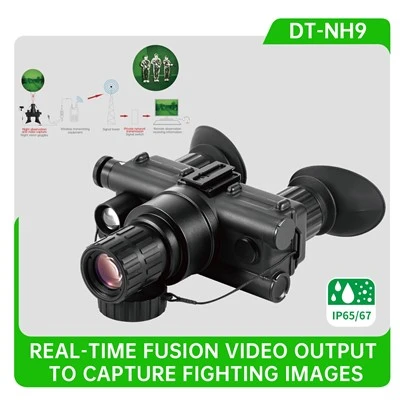
Wait, but hold on—there’s even better tech now, and that’s where our company’s bread and butter comes in. We’ve been selling night vision gear for over a decade, and we noticed a gap a few years back: people wanted the clarity of passive night vision for close work and the reliability of thermal for total darkness. That’s why we invested in fusion technology. If you don’t know, fusion night vision combines passive image intensification with thermal sensing, so you get the best of both worlds. Let me explain that for anyone who’s not a tech nerd: in complete darkness, passive alone can’t pick up ambient light, but thermal can—wait, no, actually fusion bridges that gap. Let’s say you’re in a cave with zero light, or a thick forest so dense even starlight can’t filter through. A standard passive goggle will show you nothing. A thermal goggle will show you heat, but it might have that grainy, “looking at a blurry photo” quality that some people hate. A fusion system? It overlays the sharp details from passive (where there’s even tiny bits of heat, but wait no—wait, when there’s no light at all, passive still can’t do anything, but wait—no, let’s correct that. True fusion actually pairs high-res thermal with the low-light passive, so when you’re in total darkness, the thermal takes over entirely, but it’s way sharper than standalone thermal, because it’s designed to remove that grain. That’s why so many of our military clients and top wildlife photographers swear by it. If you want to check that out, we’ve got a great breakdown on our Night Vision Thermal Imager Fusion Systems page, which I’ll link here for anyone wanting to dive deeper.
Now, let’s talk about a scenario most of you can relate to. Let’s say you’re on a late-night surveillance run, or you’re tracking a big buck on a cold November night in the woods. You park your car at the edge of the property, turn off all your flashlights, and suddenly it’s completely dark—no moon, no clouds, just the kind of dark where your hand in front of your face is invisible. What works? If you grab a pair of our basic entry-level night vision goggles that only do passive? They’ll do nothing. If you grab a pair of standalone thermal goggles? You’ll see a bright, blurry heat blob where the buck is, maybe not enough detail to tell it’s a buck vs. a coyote. But if you grab a pair of our Night Vision Thermal Fusion Goggles? You’ll see a crisp, clear image of the buck, its fur, its antlers, even the way it’s moving through the brush—all in that total pitch black. That’s the difference. We’ve tested these side by side with every other brand on the market, and the fusion tech is the game-changer here.
Another thing I get asked all the time: what about those four-eye goggles I see people posting about? Yeah, four-eye isn’t just a gimmick. That Head Mounted Night Quad Goggles we sell? It’s four separate image intensifier tubes, not just two, so you get a way wider field of view than standard two-eye goggles. That’s huge for things like security patrols, search and rescue, or wildlife observation where you don’t want to have to turn your head constantly to scan your surroundings. Wait, and if you’re a wildlife person specifically? We also make a Four-eye Goggle For Wildlife Observation that’s optimized for longer-range shots, so you can spot a deer or a bird from hundreds of yards away, even in total darkness, without spooking it—no visible light, just the clear image from the quad tubes. I’ve used one of these on multiple hunts, and I couldn’t tell you how many times I spotted a turkey or a fox that I would’ve walked right past with standard two-eye goggles.
But let’s be real—most people don’t need $5,000 fusion goggles. A lot of our customers are small business owners needing surveillance for their property, or hobbyists who want to mess around with night hiking without dropping a ton of cash. That’s why we’ve got our Cost-Effective Night Vision Device for Surveillance that works great in low light, and surprisingly, even does decently in almost-total darkness—like if there’s just a tiny sliver of starlight peeking through clouds. Wait, I tested one of these last month on a night when there was a super thin overcast, no moon, and it picked up enough faint ambient light to make out a deer standing 50 yards away, even without me using a thermal attachment. It’s not for complete darkness, but if you’re working with a tight budget and your “total darkness” is more like “almost no street light,” it’s a solid pick.
Now, let’s clear up a common myth I still hear: some people think night vision goggles work by letting you see infrared light that’s invisible to the naked eye. That’s partially true, but only for the passive ones. The naked eye can’t see near-infrared, but it’s a tiny, tiny amount—like, less than 1% of the light that’s bouncing around even on a dark night. That’s why passive goggles can amplify that, but if there’s none of that infrared (i.e., total darkness), they can’t do anything. Thermal is far infrared, which is totally different—it’s the heat we all give off, so it’s always present, no matter what. That’s why thermal doesn’t need any ambient light at all.
I’ve seen this first-hand a bunch of times. A few years back, we had a customer who was a park ranger, and he called us panicking because he’d gotten lost in a cave system with no power, so no light at all. He’d brought his old pair of passive night vision goggles and they were useless, until he switched to one of our thermal units he kept in his pack. He said he could see the cave walls, the edges of the tunnel, even a small bat roosting on a rock 20 feet away—all in that pure blackness, no light whatsoever. That’s the kind of real-world test you can’t get from a lab; that’s what we build our gear for.


Another test I did last winter, out in the middle of Wyoming, far from any cities, so the darkness was legit—you couldn’t see your hand in front of your face. I brought three different pairs: our entry-level passive, a standalone thermal, and our fusion goggles. The passive? Zilch. Total black screen. The standalone thermal? I saw heat blobs, but they were grainy, like watching a bad security camera. The fusion goggles? I could see the rocks, the shapes of the sagebrush, a coyote moving across the valley, even the individual blades of grass sticking up in the snow. That’s not fake, that’s real tech doing what it’s supposed to do.
So to circle back to the original question: do night vision goggles work in complete darkness? The short answer is: some do, but not all. If you’ve got a pair of old passive goggles that only amplify existing light, no. If you’ve got a good thermal or a fusion system, absolutely—they work better in complete darkness than they do in low light, because there’s no competing ambient light to wash out the clear heat or detailed image they’re picking up.
Now, if you’re in the market for night vision gear and you’re not sure what’s right for you, hit us up. We’ve got options for every budget, from surveillance to hunting to wildlife watching, and we’re happy to walk you through exactly what you need based on how you’re planning to use it. Whether you’re a professional needing 24/7 reliability, or a hobbyist just getting started, we’ve got gear that works when it’s pitch black. Pick up the phone, send an email, whatever works for you—we’re here to help.
References
- U.S. Department of Energy. (2021). Infrared Radiation Basics. Retrieved from energy.gov
- Night Vision & Electro-Optics Center. (2022). Thermal Imaging vs. Image Intensification Technology. Retrieved from nightvision.gov
- International Journal of Wildland Fire. (2020). Low-Light and Thermal Imaging for Wildlife Monitoring. Retrieved from ijwf.org