If you’ve ever wondered how thermal binoculars turn invisible heat into clear, usable imagery—whether you’re a hiker after dusk, a hunter tracking game, or someone who just wants to see through fog and darkness—you’re not alone. I’ve spent the last eight years as part of the team at our thermal imaging company, helping customers cut through the hype and understand exactly how these tools work. Let’s break it down, no jargon overload, and I’ll weave in some of the binoculars our team is proud to offer along the way.
First, let’s get one core fact straight: thermal binoculars don’t rely on visible light. That’s the biggest difference between them and regular binoculars, night-vision goggles, or even your phone’s camera. Every object on Earth emits infrared (IR) radiation as heat—this is called blackbody radiation, and it’s not visible to the human eye. A hot pan glows with it, your dog glows with it, even the snow glows with it (just much, much less). Thermal binoculars’ entire job is to capture that invisible IR light and turn it into a picture your brain can interpret.
The process starts with the core component that makes all this possible: an infrared detector array. Unlike the tiny pixels on your phone, which capture visible light, thermal detector pixels are calibrated to pick up tiny temperature differences (as small as 0.05°C, in many quality models). Think of this array as a grid, usually between 320×240 and 640×512 pixels, that scans the scene in front of you and maps temperature values to color values. For example, a 100°F deer might show up as bright white, a 50°F rock as medium gray, and 30°F grass as dark brown—each hue represents a specific temperature, so you can instantly tell what’s warm, cool, or somewhere in between.


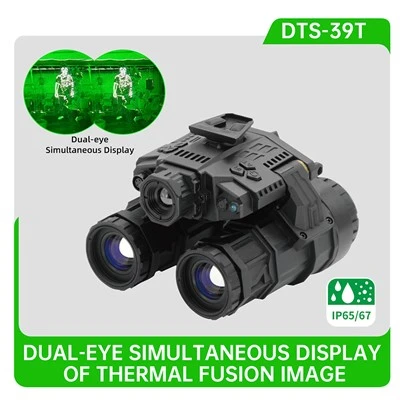
But a single detector array is only part of the story. Modern thermal binoculars take this a step further with thermal fusion, which combines thermal data with visible light imagery to create a clearer, more useful view than thermal alone. Our High Definition Thermal Fusion Binoculars use this exact technology, blending the heat details that make targets stand out from the background with the familiar, color-rich look of regular daylight imaging. So instead of looking at a high-contrast black-and-white (or false-color) thermal image, you get a view that’s easy to parse even when you’re scanning for small details at a distance. It’s a game-changer for outdoor use, because you can still pick up terrain features, trail markers, or landmarks that thermal-only might wash out.
Once the detector array captures the IR data, it sends that information to a signal processor. This is the “brain” of the binocular, and it’s responsible for a few key tasks: first, calibrating the temperature data to make sure colors accurately reflect heat (no one wants to mistake a warm rock for a game animal). Second, cleaning up noise—thermal detectors can pick up static from their own internal components, especially in cold weather, so the processor filters that out to keep the image sharp. Third, adjusting dynamic range: if you’re standing in a scene with both a warm campfire and cold trees in the background, the processor balances the brightness so you can see both clearly without overexposing the fire or making the trees invisible.
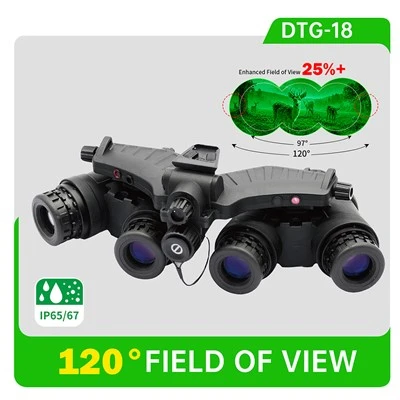
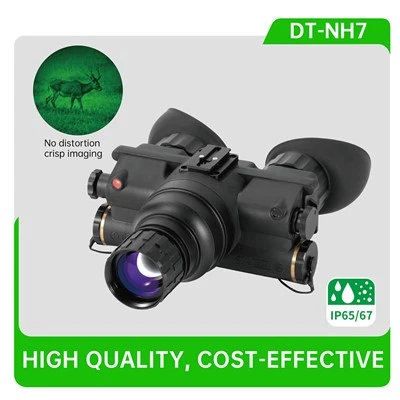
Now, let’s talk about the binocular part of thermal binoculars, which is different from a scope or a monocular. Most quality models use a dual eye viewing system—what we call the Thermal Binoculars with Dual Eye Viewing System on our site. Instead of a single eyepiece for one eye, you get two, one for each eye, just like regular handheld binoculars. Why does that matter? For one thing, it reduces eye strain during long uses—if you’re glassing a hunting spot at 2 a.m. for hours, you don’t want one eye craning at a single screen. More importantly, a dual eye setup with proper alignment creates binocular vision, which gives you depth perception. That’s the ability to tell how far away an object is, something monocular thermal tools struggle with. If you’ve ever tried to judge the distance of a target with one eye closed, you know how tricky it is—thermal binoculars with this system fix that, making them ideal for both hobbyists and professionals.
Speaking of depth perception, some of our most popular models take this a step further with built-in depth measurement tools, which is exactly what our Thermal Imaging Binoculars with Depth Perception offer. These models combine the dual eye system with a slight offset in the two thermal detectors, letting the processor calculate the distance to objects in the scene. For hunters, that means knowing exactly how far away a deer is before taking a shot; for search and rescue teams, it means quickly locating a missing person and relaying their position accurately. It’s a small feature that adds a ton of functionality, especially for professional users.
Let’s get into a few more technical details that matter for anyone shopping for thermal binoculars, because not all models are created equal. The resolution of the detector array is one of the biggest factors in image clarity—you’ve probably seen numbers like 320×240 or 640×512 thrown around. That first number is the number of horizontal pixels, the second vertical, so a higher number means more detail. Our 640×512 Resolution Thermal Imaging Binocular is our top-tier model for long-range use, with twice as many pixels as entry-level 320×240 models. What does that look like in real use? At a half-mile away, the 640×512 model will show you the shape of a rabbit’s ears or a duck’s head, while a lower resolution model might just look like a warm blip against the grass. That detail matters when you’re trying to distinguish game from a fallen log, or a person from a bush in low light.
Another key component is the lens. Thermal binoculars use germanium or silicon lenses, not the glass lenses of regular binoculars, because those materials are transparent to infrared light. The quality of the lens coatings and the size of the lens affects how much IR light reaches the detector, which in turn affects how far the binoculars can “see” (their detection range). Entry-level models might have small, uncoated germanium lenses that only pick up heat out to 300 or 400 yards, while professional models have larger, multi-coated lenses that can detect and identify targets out to 1,000+ yards. That’s why our Professional Thermal Binoculars for Outdoor are so popular with guides and wildlife researchers—they’re built to stand up to rugged conditions, with weather-sealed bodies that work in rain, snow, and -20°F temperatures, and lenses that maximize performance even in the harshest environments.
Wait, let’s address a common myth I hear all the time: thermal binoculars work the same as night vision goggles. Nope, totally different. Night vision amplifies existing visible light (like moonlight or street lights) to make it bright enough to see—so if you’re in total, 100% darkness with no light at all, night vision is useless. Thermal doesn’t care about visible light at all—it works on heat, so it works in complete darkness, through heavy fog, smoke, and even light rain or snow. That’s why they’re used by search teams, border patrol, and hunters who hunt after full dark, not just at twilight.
Let me also walk you through a real-world example to make this concrete. Last winter, I took our dual eye thermal binoculars out to a state park for a night hike. The temperature was 25°F, and the moon was hidden behind clouds—no visible light at all. When I pulled the binoculars up to my eyes, the first thing I saw was the warm glow of a red-tailed hawk perched 100 yards up in a tree. The rest of the tree branches were cool, so they looked dark against the bright hawk, and I could see the shape of its wings and the curve of its beak. The dual eye system let me tell it was 100 yards away, not 50 or 200, which would have been impossible with a monocular. Half a mile down the trail, I spotted what turned out to be a deer—its body was a warm, reddish-white, while its legs were a little cooler, so it stood out clearly from the surrounding dark, cool pine trees. That’s thermal binoculars in action, and it works every single time you need to see when there’s no light.
Now, I want to be honest about the limits too, because no tool is perfect. Thermal binoculars can’t see through solid objects like walls or thick tree trunks—heat from an object on the other side will be blocked, so it just looks like a cool spot behind the obstacle. They also can’t detect very small, cool objects from extreme distances—you won’t see a single squirrel a mile away, for example. And while they work great in fog, heavy rain or snow can scatter IR light, reducing range a little, though modern models like our professional line are designed to minimize that effect.
Over the years, I’ve worked with hundreds of customers, from weekend campers to large law enforcement teams, and the question I get most is: which thermal binocular is right for me? If you’re a casual hiker who only uses them for occasional trail walks after dusk, an entry-level 320×240 model might be more than enough. If you’re a hunter who stalks big game at dawn and dusk and needs to identify targets at long range, our 640×512 model with thermal fusion is probably your best bet. And if you’re someone who needs to do long glassing sessions without eye strain or precise distance measurements, our dual eye or depth perception models will fit your needs perfectly.
At the end of the day, thermal binoculars aren’t just a fancy toy—they’re a tool that lets you connect with the outdoors in a way traditional optics can’t. Whether you’re finding your way in total darkness, tracking game, or helping search for a missing loved one, they turn the invisible world of heat into something you can use.
If you’re ready to learn more or place a bulk order for your team, organization, or business, we’re here to help. We can walk you through the specs of any of our models, answer questions about use cases, or arrange a demo if you’re local. We don’t do high-pressure sales—we just help people find the right thermal solution for their needs, no matter how big or small.
References
- Gauss, J. (2021). Thermal Imaging Technology: Principles and Applications. SPIE Press.
- Jennings, T. (2019). “Blackbody Radiation and Thermal Detectors.” Journal of Optical Engineering, 58(6), 061908.
- Outdoor Industry Association. (2022). “Thermal Optics Usage and Benefits for Recreational and Professional Outdoor Activities.”
- Smith, K. (2020). “Dual-Eye Viewing Systems for Handheld Thermal Binoculars: Ergonomics and Performance.” Applied Ergonomics, 86, 103089.