Detyl Optics / Observation Selection
One detects heat, the other amplifies light: choose by task
Both are bought for the same reason and fail in different conditions. Decide which question the observer must answer before you request a quote.
Key takeaways
- Night vision amplifies available light; thermal reads temperature difference. Neither upgrades the other.
- Start from the light on site, then from what must be separated: heat or detail.
- Field of view, mounting and power decide the result more than the sensor headline.
- Fix the acceptance record before ordering, and confirm export eligibility per destination.
In this article
01 · What each one measures · 02 · Start from the light · 03 · Contrast vs detail
04 · Match the task · 05 · Field of view and mount · 06 · Fusion and clip-on
07 · Acceptance and limits · FAQ
The question night vision vs thermal imaging is usually asked by someone who must buy one device without testing both. They solve different problems. Night vision intensifies the small amount of light already present, including near-infrared, and returns an almost photographic image. Thermal imaging ignores light and builds the picture from temperature difference: it works with no illumination at all, but shows less surface detail.
This guide is for distributors and procurement teams who sign off the specification. Two published Detyl models are the reference points: the DTS-14 night vision monocular and the DT-TW21 thermal monocular.
01 · What each device actually measures
Night vision is an image-intensification chain: light strikes a photocathode, the released electrons are multiplied onto a phosphor screen, and the scene returns as a bright monochrome image with readable texture, foliage and clothing. The DTS-14 is published as Gen 2+ with Gen 3 optional, 1X, 60–64 lp/mm, 18–24 signal-to-noise, 50° field of view, built-in 850 nm 10 mW illuminator, IP65 with IP67 optional, 240 g finished.
Thermal imaging is radiometric: an uncooled detector reads the 8–12 µm band and turns temperature difference into a picture. Nothing is amplified, so darkness costs it nothing, but fine detail is scarce. The DT-TW21 is published with a 384×288 detector, 1.2X, 36° field of view (32° as a clip-on), IP67, 140 g and 3.5–4.5 h on one CR123A.
Practical consequence
Night vision answers "what is this?". Thermal answers "is something there?". Most wrong purchases come from ordering one device to answer the other question.
02 · Start from the light at the observation point
Describe the site in light terms before opening any data sheet: moon or star light, spill from buildings and lamps, observer inside looking out, and whether the view crosses glass, mesh or canopy. Night vision tracks those answers; thermal barely reacts to them.
- Good ambient light: night vision returns structure, which shortens training.
- Almost no light: night vision leans on its illuminator, and 850 nm light reflects back from glass, water and wet surfaces.
- Haze, drizzle, foliage: visible and near-infrared contrast collapses; a thermal silhouette usually survives.
- Bright light: the DTS-14 lists automatic brightness control and bright-light cut-off, but that protects the tube; it does not make viewing lamps or the sun acceptable.
Write those answers into the inquiry: they settle the night vision vs thermal imaging question before any model is quoted.
03 · Contrast versus detail: the comparison that matters
| Consideration | Night vision | Thermal imaging |
|---|---|---|
| What it reads | Available light plus near-infrared | Temperature difference, 8–12 µm |
| No light at all | Needs an illuminator or ambient light | Works without any light source |
| Surface detail | High: texture, clothing, markings | Low: shapes and heat patterns |
| Concealment | Defeated by nets and dense brush | Silhouette stands out from cooler surroundings |
| Through glass | Usable if light passes; reflections can spoil it | Ordinary glass blocks the band |
| Cost driver | Tube generation and grade | Detector resolution and lens aperture |
Read the table as a trade between contrast and detail. Thermal gives contrast against clutter, which is why it separates a subject from a hedge; night vision gives detail, which is why it separates one object from another at the same temperature. A night vision vs thermal imaging choice that skips this row ends up arguing about brand.
Note what the table omits: range figures. Published ranges depend on target size, temperature difference, atmosphere and observer skill, so one number in a brochure is not something you can hand to a client.
04 · Match the device to the observation task
| Observation task | First choice | Why |
|---|---|---|
| Fixed watch over a dark open area | Thermal monocular | No dependence on light |
| Patrolling a site with a wide sweep | 1X night vision monocular | 50° field of view, low fatigue |
| Recording what an object is | Night vision, tube quality first | Resolution and signal-to-noise carry detail |
| Finding something concealed in vegetation | Thermal | Heat is not hidden by visual pattern |
| Observation through a dedicated optical sight | Night vision scope | Integrated eyepiece, reticle and magnification; IP67 on the DT-NS series |
| Adding heat detection to goggles in service | Thermal clip-on | Keeps the existing mount, adds a second channel |
Two rows deserve a comment. Wide scanning is a field-of-view problem before it is a resolution problem: 50° covers a corridor in one pass, 36° keeps the observer panning. And an integrated scope is not a monocular with a mount; it carries the reticle, eye relief and magnification the task expects.
Where two tasks conflict, buy for the primary one or specify two devices.
05 · Field of view, magnification and mounting
Three mechanical facts decide whether the observer is effective: how much of the scene is visible at once, how much it is magnified, and how the device is carried. All three can be checked against a site drawing.
Worked example: covering a 90° sweep
Take a riverbank watched across roughly 90° of horizontal angle, and divide that angle by the field of view.
At 50° (night vision): 90 ÷ 50 = 1.8, so two overlapping positions cover the sweep.
At 36° (thermal): 90 ÷ 36 = 2.5, so three positions are needed. The extra positions are a staffing cost, not a device defect.
Magnification reverses the logic. More magnification puts more pixels on the target but narrows the view and amplifies hand movement, so it belongs on a supported instrument. At 1X the image is stable by hand and the view is broad.
Mounting is where projects slip. Confirm the shoe, the helmet interface and eye relief before ordering, and confirm the weight on the head rather than on the desk: the DTS-14 is published at 240 g finished and converts to helmet use with commercially available mounts, while the DT-TW21 is 140 g handheld, 144 g head-mounted and 92 g as a clip-on.
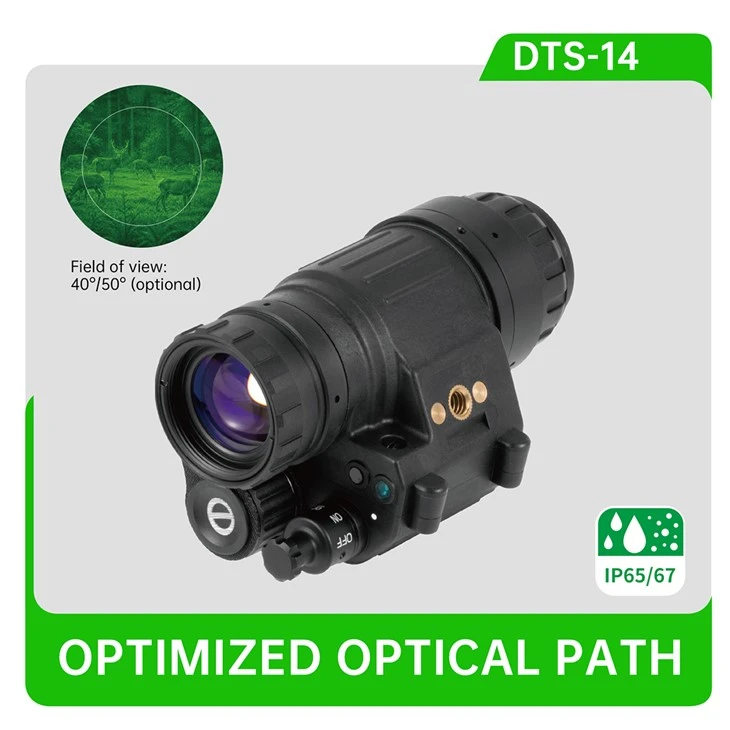
DTS-14 high-gain night vision monocular: Gen 2+ with Gen 3 option, 1X, 50° field of view, built-in 850 nm illuminator.
06 · Fusion and clip-on: when the answer is both
Some tasks need heat contrast and surface detail in one view. The practical answer is a clip-on thermal module in front of an existing night vision device, so the thermal outline overlays the intensified image. The DT-TW21 is published as handheld, head-mounted and clip-on, with listed compatibility for PVS31, PVS14, NVG18, DTS31, DTS35, DTGI8, DTNH9 and DTS13 bodies.
Fusion is not free. It adds an alignment step, because the thermal channel must be collimated to the host or the overlay sits off-centre and misleads the observer. It adds mass in front of the eye and a second battery, and narrows the thermal field from 36° to 32°. Specify it when both readings are needed, and agree a written alignment check at handover.

DT-TW21 thermal monocular: 384×288 uncooled detector, 8–12 µm, IP67, 3.5–4.5 h runtime, clip-on mode for fusion.
07 · Acceptance record and use limits
The last comparison in a night vision vs thermal imaging decision is between what the quotation promised and what the delivery proves. Agree the record below before ordering, then repeat them on a sample unit.
| Item | Record at handover |
|---|---|
| Imaging core | Tube generation, resolution, signal-to-noise, or detector resolution and wavelength |
| Optics | Magnification, field of view, objective aperture, diopter range |
| Mechanical | Mount interface, weight as carried, IP rating claimed |
| Environment | Operating temperature and humidity range, fog-proof construction |
| Power | Battery type, stated runtime, pack included or not |
| Compliance | Destination, end user and end use needed for export review |
State the use limits in writing too. Neither technology replaces a risk assessment, and a device that performs in a demonstration may behave differently in rain, in cold, or with a scratched objective. Night vision should not be left pointed at bright sources, thermal contrast falls in heavy atmospheric moisture, and a fogged window costs contrast too.
Treat export control as a purchase step, not a shipping detail. Optical night vision and thermal equipment can fall under dual-use or export licensing rules depending on destination, end user and application. Detyl confirms eligibility case by case against the stated destination and end use before an order is confirmed, and no configuration should be promised to a restricted destination in advance.
Frequently asked questions
Can a thermal imager see through glass?
No. Ordinary glass blocks the long-wave infrared band, so viewing from indoors through a window does not work. Night vision can be used behind glass when there is enough light, though illuminator reflections may interfere.
Does thermal work in complete darkness?
Yes, because it reads temperature difference rather than light. Contrast still depends on weather: rain, fog or snow reduce the temperature difference the detector can resolve.
Is night vision useless without moonlight?
Not useless, but dependent. Under overcast skies the image gets grainier and the illuminator, such as the 850 nm unit on the DTS-14, becomes the main light source.
Which is better for wildlife observation?
It depends on what must be recorded. For behaviour, plumage and habitat detail, night vision gives the more readable image. For finding animals among vegetation, thermal is more reliable.
Can a thermal clip-on work with goggles we own?
Often yes, if the mount and optical interface match. Detyl lists DT-TW21 compatibility with PVS31, PVS14, NVG18, DTS31, DTS35, DTGI8, DTNH9 and DTS13 bodies.
What should we send with an inquiry?
Send the observation task, the light conditions on site, whether the device is handheld, head-mounted or clip-on, the field of view expected, power preference, quantity, delivery date, destination and end use. Those answers settle the night vision vs thermal imaging choice in one reply.
Next step
Describe the scene and the task. We confirm the model, the core and the mount.
Share the light conditions, the observation task, mounting method, field of view expectation, quantity and destination. Detyl replies with the matching configuration and the documents for your own night vision vs thermal imaging comparison.
Email sales@detyl.com or use the inquiry form. You can also review the night vision range, the thermal imaging range, or the night vision scopes.
Request a configuration review